If you’ve ever spent weeks vetting a fragrance supplier only to find out their “certifications” were basically a PDF with a logo on it, you know how frustrating this process can be. Picking a perfume fragrance supplier isn’t just a sourcing decision — it’s the thing that determines whether your product actually smells right, clears customs without a headache, and makes you money instead of eating your margin.
So before you sign anything, here’s what actually matters: can the supplier prove their certifications? Can they prove they can produce at the volume you need? And can they prove people already buy their products? If a supplier can’t back up all three with something you can check yourself, keep looking.
What Actually Makes a Fragrance Supplier Worth Working With
Forget the sales pitch for a second. Here’s the real checklist:
- Quality certification — ISO 9001, ideally audited by a name you recognize (Bureau Veritas, SGS, etc.)
- Cosmetic manufacturing standards — CGMP-ASEAN or equivalent
- Regulatory registration in the markets you’re shipping to (US FDA if you’re touching the US)
- Real numbers on production capacity — bottles per month, not “large scale facility”
- Actual OEM or private label clients they can name, not just imply
- Proof their own products sell — retail presence, e-commerce listings, something you can go look at
Most perfume suppliers can check one or two boxes. Almost none can check all six with documentation you can actually verify. That’s the gap worth paying attention to.
How to Actually Verify Each of Those, Instead of Just Taking Their Word
Anyone can put “ISO 9001 certified” on a website. Here’s how you check if it’s real, and what should make you pause:
- Certifications — Ask for the certificate number and the name of the issuing body (Bureau Veritas, SGS, TÜV, etc.), then look it up yourself or ask the certifier to confirm it directly. Red flag: a supplier who sends you a logo image instead of a document with a number on it.
- Manufacturing standards (CGMP) — Ask which specific CGMP standard they follow (CGMP-ASEAN vs. a generic in-house version) and whether it’s been externally audited. Red flag: vague answers like “we follow international standards” with no name attached.
- Regulatory registration — For US-bound goods, ask for their US FDA facility registration number, which you can check against the FDA’s own database. Red flag: refusal to share the number, or a registration that’s expired.
- Production capacity — Ask for monthly output by product category, not total factory size. A big building doesn’t mean big output. Red flag: capacity numbers that keep changing depending on who you ask.
- OEM/private label clients — Ask for at least one client reference you can actually contact, not just a logo wall on their homepage. Red flag: client names that can’t be verified or that decline to confirm the relationship when asked.
- Retail proof — Check if their products are genuinely listed on the retailers or marketplaces they claim, using the retailer’s own site or app. Red flag: retail names mentioned in a pitch deck but nowhere to be found when you actually search.
If a supplier flinches at any of these requests, that’s information too
Saigon Cosmetics Corporation: Company Overview
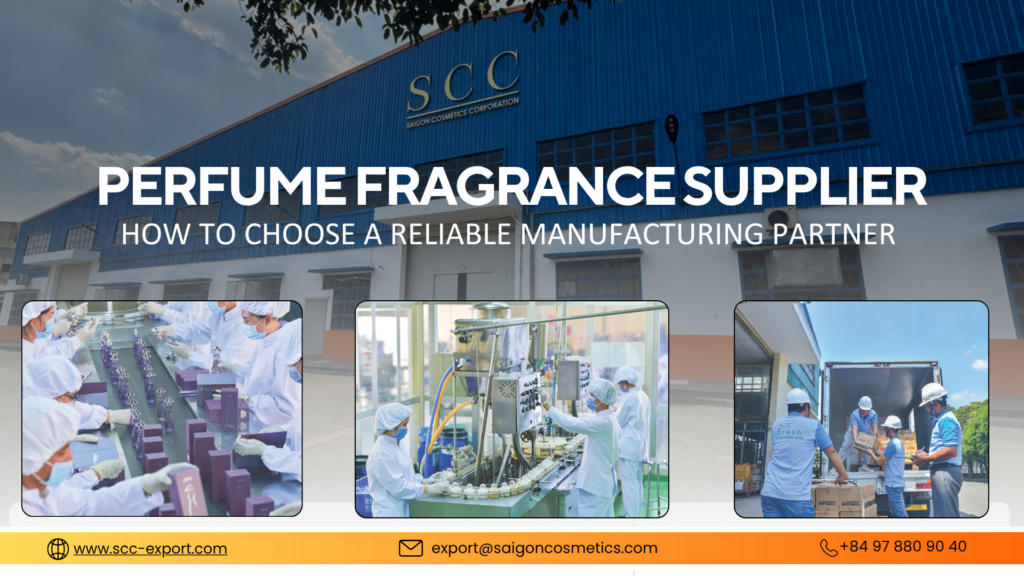
Saigon Cosmetics Corporation (SCC) is a Vietnamese personal care and fragrance manufacturer headquartered in Cat Lai Industrial Park, Ho Chi Minh City. The company traces its origins to a French-established perfume factory (Imortel Perfumes, 1990), was nationalized in 1975, restructured as Saigon Cosmetics Corporation in 1999, and became a public company in 2007.
Today SCC operates:
- A 17,000 m² facility, including 6,000 m² of dedicated production space
- Approximately 500 employees
- Three business lines: Cosmetics, Personal Care, and Home Care
- Active commercial operations in Vietnam plus 10 export markets, including the Philippines, the United States, China, Indonesia, Malaysia, Singapore, Cambodia, Myanmar, Laos, and Samoa
Verified Certifications and Compliance
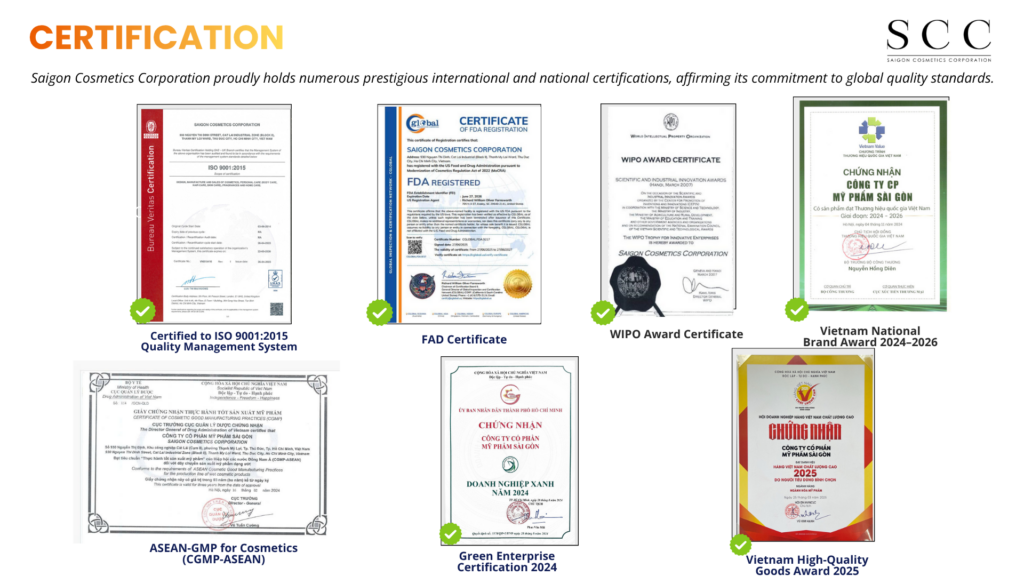
SCC’s compliance credentials are third-party audited or government-issued, not self-declared:
- ISO 9001:2015, certified by Bureau Veritas
- CGMP-ASEAN compliance for cosmetic manufacturing
- US FDA registration
- Vietnam National Brand recognition, 2024–2026
- Vietnam High-Quality Goods Award, awarded for 18 consecutive years
- Green Enterprise Certification (2024)
These aren’t self-issued badges. They’re the kind of paperwork your own compliance team can independently check — which matters a lot more than it sounds like it does, especially once your shipment is sitting at customs.
Production Capacity
For buyers evaluating whether a supplier can support real order volumes, SCC’s monthly manufacturing output includes:
| Product Category
|
Monthly Capacity
|
|---|---|
| Perfume (EDP/EDT bottles)
|
400,000 units
|
| Aerosol products
|
200,000 units
|
| Shampoo & shower products
|
300,000 liters
|
| Sachets
|
1,800,000 units
|
| Soap
|
30 tons
|
That’s enough scale to handle both their own branded lines and OEM orders in-house, without quietly outsourcing your order to some subcontractor you’ve never heard of.
A Proven Track Record in the Vietnam Market
Instead of throwing around a ranking claim nobody can check, here’s what you can actually go verify:
- 26,429+ active points of sale across Vietnam — general trade, modern trade, key accounts, all of it
- On shelves at AEON, CoopMart, GO!, LOTTE Mart, WinMart, Guardian, Emart, and Satramart
- Sold on Shopee, TikTok Shop, Lazada, and Alibaba
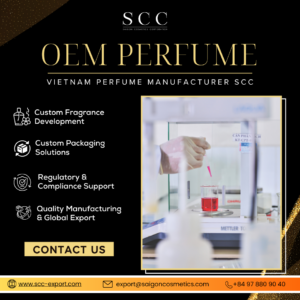
- OEM and private label work for real, nameable clients — Pharmacity, Jollibee, LOTTE Mart, LG Vina Cosmetics, MiniSo
That combination — thousands of retail points plus recognizable OEM clients — tells you a lot more than any “#1 in Vietnam” tagline ever could, mostly because you can go check every part of it yourself.
Fragrance Portfolio
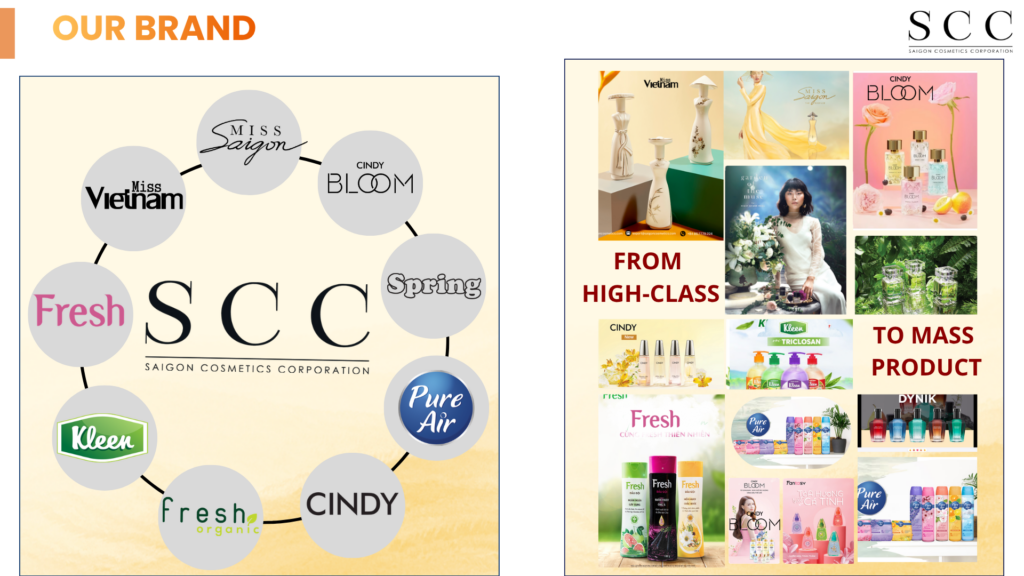
SCC perfume manufacturer across multiple fragrance tiers, which is relevant for buyers segmenting by price point:
- Miss Vietnam — luxury, packaged in Minh Long porcelain bottles
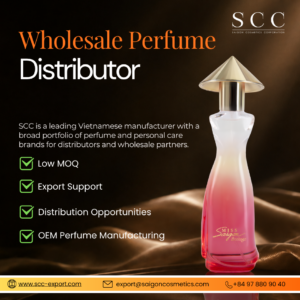
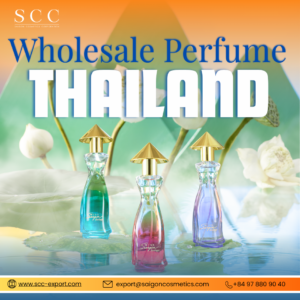
- Miss Saigon — a Vietnam National Brand-recognized line inspired by Vietnamese heritage (áo dài and nón lá-inspired bottle design)
- Cindy Bloom / Cindy — mid-tier and mass-market ranges
- Dynik — men’s fragrance and grooming line
This range allows a single supplier relationship to cover multiple retail price segments, which can simplify sourcing for distributors carrying more than one brand tier.

Exporting from Vietnam: Why It Matters for Philippine Buyers
Buyers in the Philippines sourcing a perfume fragrance supplier have a specific structural advantage when working with a Vietnam-based manufacturer: under the ASEAN Trade in Goods Agreement (ATIGA), qualifying goods move between Vietnam and the Philippines at 0% tariff. Combined with relatively short shipping lead times within ASEAN, this makes Vietnam-manufactured fragrance products commercially competitive against suppliers based outside the trade bloc — without sacrificing the certification standards (CGMP-ASEAN, US FDA) that Philippine retailers and distributors typically require from an OEM or import partner.
Frequently Asked Questions
What certifications should a perfume fragrance supplier have? At minimum, ISO 9001 for quality management and CGMP for cosmetic manufacturing practices. Suppliers exporting to the US should also hold US FDA registration.
Can a Vietnamese fragrance manufacturer produce private label perfume for the Philippine market? Yes. Vietnam-based manufacturers with CGMP-ASEAN and export experience can produce private label and OEM fragrance products for Philippine distributors, with ATIGA providing a 0% tariff advantage on qualifying shipments.
How do I verify a fragrance supplier’s production claims? Ask for certification numbers (ISO, CGMP) that can be checked against the issuing body, request references from existing OEM clients, and ask for facility size and monthly output figures rather than accepting general statements of scale.
Working with SCC
Buyers evaluating Saigon Cosmetics Corporation as a perfume fragrance supplier — for OEM, private label, or distribution partnerships — can request certification documents, product samples, and MOQ/pricing details directly.
Contact: export@saigoncosmetics.com | +84 97 880 90 40 | www.scc-export.com | Cat Lai Industrial Park, Ho Chi Minh City, Vietnam