If you’ve searched “bulk perfume supplier” chances are you’ve already talked to a few factories and gotten a mix of vague answers, confusing quotes, and prices that don’t seem to line up with each other. That’s normal — this industry isn’t always transparent, and a lot of buyers end up guessing.
This article is our attempt to make that easier. Not a sales pitch, just the honest version of what actually matters when you’re sourcing perfume in bulk: how pricing really works, what “certified” should actually mean, and how to tell a supplier who can deliver from one who just talks well.
Who We Are, and Why We’re Writing This
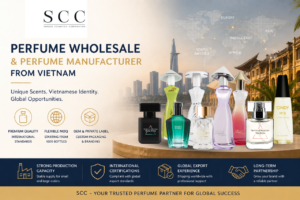
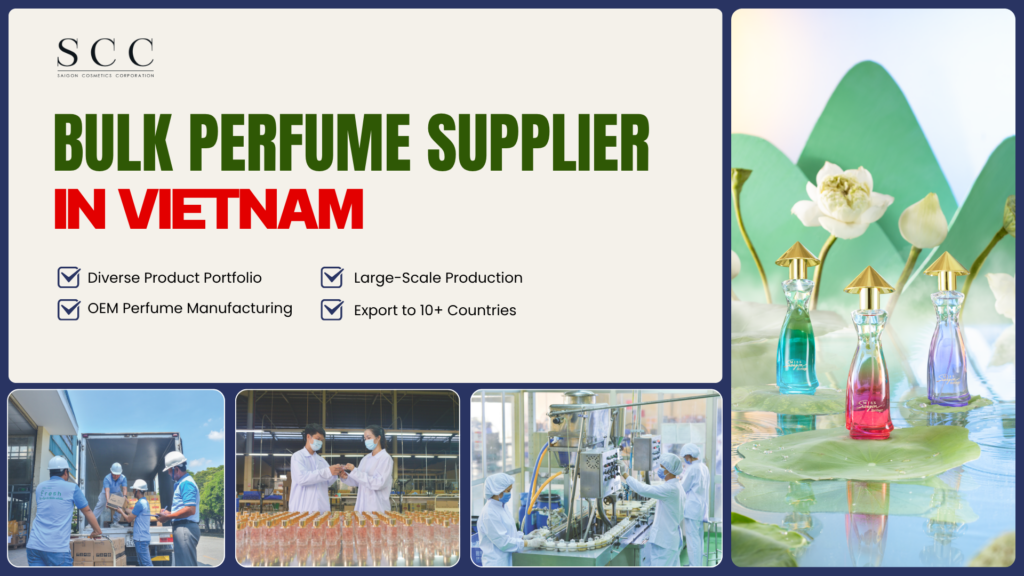
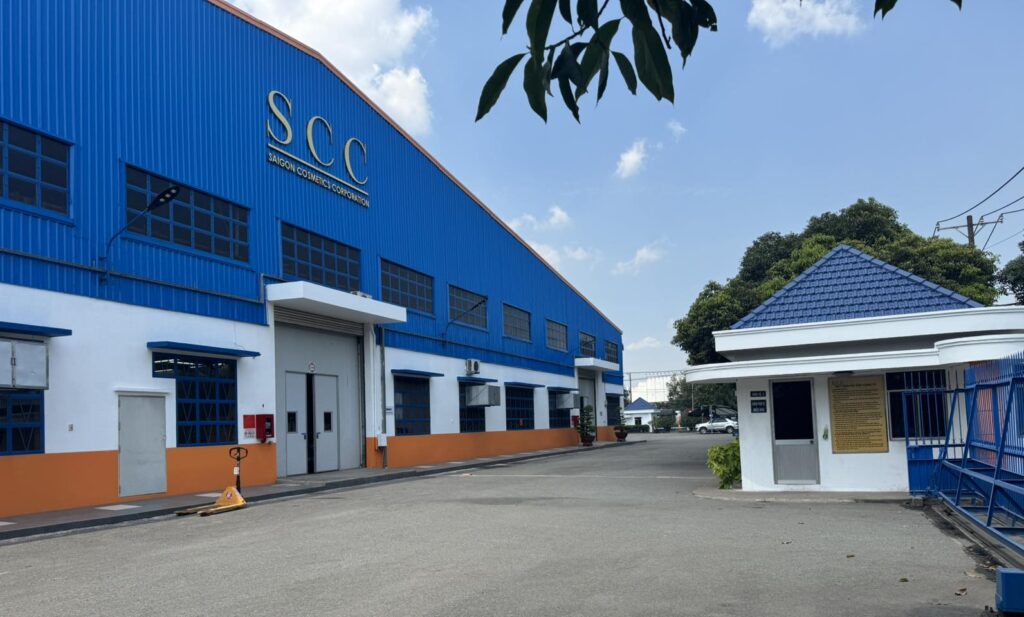
We’re Saigon Cosmetics Corporation (SCC), a perfume and personal care manufacturer based in Ho Chi Minh City, Vietnam. We’ve been making fragrance and personal care products, since our factory started as a French perfume plant before that. Today we run our own production lines out of a 17,000m² facility, sell in over 26,000 stores across Vietnam, and export to buyers across Southeast Asia and beyond.
We’re writing this because we talk to buyers like you every week, and we keep hearing the same confusion — about pricing, about certifications, about who to trust. So this article is basically the answer we wish more suppliers gave upfront, instead of making you ask five times.
Why Bulk Pricing Isn’t Linear — and Why That Matters for Your Order Size
A common mistake buyers make is assuming that bulk pricing scales smoothly — order 2x the volume, pay roughly 2x less per unit. In reality, perfume manufacturing costs move in step-changes tied to production batch sizes, not smooth curves.
Here’s the mechanism: concentrate formulation, bottle molds, and filling line setup all have fixed costs that get amortized across a batch. If your order size sits just below a supplier’s next batch threshold, you’re absorbing the full fixed cost per unit. If you can size your order to just clear that threshold, your per-unit cost can drop meaningfully — sometimes more than the volume increase alone would suggest.
This is why asking a supplier “what’s your bulk price” produces a next-to-useless answer. The right question is: “What are your production batch tiers, and where do the price breaks sit?” A manufacturer that can answer this immediately, with specific volume thresholds, is telling you they actually run structured production — not blending small runs and marking up the difference. SCC, for example, structures perfume production around defined batch capacity — up to 400,000 bottles per month across its Cat Lai facility — which is the kind of concrete production ceiling that lets a buyer reverse-engineer where their order sits relative to a full batch run, rather than negotiating blind.
The Real Difference Between Sourcing Regions
Buyers often frame supplier comparison as “which country has cheaper labor,” which misses most of what actually affects total landed cost and risk. Here’s a more accurate breakdown:
| Factor
|
Vietnam (ASEAN)
|
China
|
South Korea
|
|---|---|---|---|
| Import tax into ASEAN countries
|
0% under ATIGA (intra-ASEAN trade agreement)
|
Standard MFN tariff applies, varies by destination country
|
Standard MFN tariff applies, varies by destination country
|
| Meeting ASEAN safety/registration rules
|
CGMP-ASEAN certification directly satisfies most ASEAN cosmetic registration requirements
|
Requires separate compliance mapping per destination market
|
Requires separate compliance mapping per destination market
|
| Best fit for
|
Mid-volume B2B distributors, OEM/private-label brands entering ASEAN
|
Very high-volume orders, mature global supply chains
|
Trend-driven, K-beauty-adjacent positioning
|
| Common risk for smaller buyers
|
Fewer manufacturers with English-language B2B export infrastructure — requires more due diligence per supplier
|
High MOQs can price out mid-size distributors; quality variance across factories is wide
|
Premium positioning often carries premium pricing that doesn’t scale down well for bulk value orders
|
The tax part is bigger than it sounds. If you’re shipping into the Philippines or Thailand, paying 0% tax on every container from Vietnam isn’t a one-time saving — it adds up every single order, every year. Over time, that’s real money back in your margin.
The compliance part matters too, just less obviously. If your supplier’s certifications don’t match what your country requires, that problem becomes yours — customs holding your shipment, paperwork getting rejected, products stuck at the border. Sourcing from a CGMP-ASEAN certified factory means that headache is already handled before you even place your first order.
None of this means Vietnam is automatically the “right” choice — if you already have a solid relationship in China and order huge volumes, it might still make sense to stay there. But it’s worth actually comparing the numbers instead of just going with whoever everyone else uses.
What to Actually Verify Before You Order?
Most sourcing mistakes happen because buyers skip one of these steps:
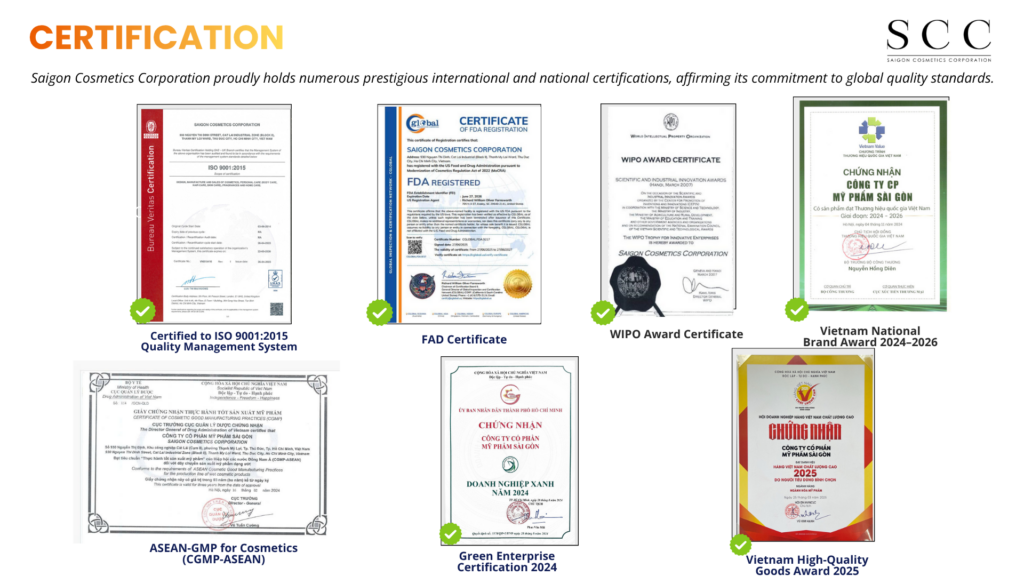
Certification — verify, don’t take at face value. ISO 9001:2015 should be issued by a recognized third-party body (Bureau Veritas is one common issuer) — ask for the certificate number and issuing body, not just a logo on a website. If a supplier is targeting US-bound orders, confirm active FDA registration status. If the supplier claims CGMP-ASEAN, this should be a specific, checkable certification — not a general “we follow good manufacturing practices” claim.
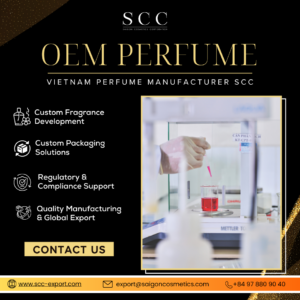
OEM track record — ask who they’ve actually produced for. A supplier’s OEM client list tells you more than their marketing copy does. A factory that has run private-label production for recognizable retail or F&B accounts has already been audited against retail-grade specs, timelines, and consistency requirements — that’s a different risk profile than a factory whose largest client is its own house brand. SCC’s OEM production history includes accounts such as Pharmacity, LOTTE Mart, MiniSo, and Jollibee — retail and F&B brands with their own quality audit processes, which is a useful proxy for whether a supplier can hold spec at scale.
Production capacity vs. your order size. Ask directly: at your target volume, are you a priority order or a filler order squeezed between larger clients? A supplier with monthly capacity clearly larger than your order (SCC’s stated capacity: up to 400,000 perfume bottles/month) gives you more room to negotiate turnaround time and batch scheduling than one operating near its ceiling.
Export documentation experience in your specific destination market. A manufacturer that already exports to your target country has already solved the customs and labeling requirements you’d otherwise discover mid-shipment. Confirm this with named markets, not a general “we export internationally” claim — SCC currently exports to markets including the Philippines, the United States, Singapore, Malaysia, Indonesia, and Cambodia.
Frequently Asked Questions
What is a realistic Minimum Order Quantity (MOQ) for bulk perfume manufacturing?
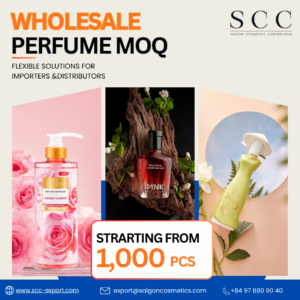
Realistic MOQs typically range from 1,000 to 10,000 units per SKU depending on custom bottle tooling, cap selection, and fragrance oil concentration. Always ask for tiered MOQ pricing to evaluate cost savings at higher volumes.
Is a bulk perfume supplier the same as a wholesale perfume supplier?
The terms overlap but aren’t identical. “Bulk” typically refers to production volume and manufacturing economics — how a supplier prices and structures large production runs. Wholesale perfume sourcing refers more broadly to the commercial relationship: distribution terms, resale pricing structure, and ongoing supply agreements. In practice, most B2B buyers evaluate both together, since the manufacturer capable of bulk production is usually the same one you’d structure a wholesale supply agreement with.
How do I verify a supplier’s certifications are real?
Ask for the certificate number and issuing body directly, and cross-check with the certifying organization where possible (e.g., Bureau Veritas for ISO certifications). Legitimate suppliers provide this without hesitation; hesitation or vague answers on specific certification details is itself a signal.
Does sourcing from Vietnam make sense outside ASEAN markets?
The tariff advantage (ATIGA 0%) is specific to ASEAN-to-ASEAN trade, so it applies most directly if your distribution target is within Southeast Asia. Outside ASEAN, the case for Vietnam sourcing rests more on production capacity, certification standards (ISO, FDA registration), and pricing competitiveness rather than tariff structure.
Working with SCC
Buyers evaluating Saigon Cosmetics Corporation as a bulk perfume supplier — for OEM, private label, or distribution partnerships — can request certification documents, product samples, and MOQ/pricing details directly.
Contact: export@saigoncosmetics.com | +84 97 880 90 40 | www.scc-export.com | Cat Lai Industrial Park, Ho Chi Minh City, Vietnam