A distributor committing to a product naturally wants to know about competition. Can you become an exclusive perfume distributor for SCC, and on what terms? Yes, by product and by country. This article covers when to move from buying to exclusivity, what SCC supports, order conditions, and how to assess an agreement before signing.
What Is an Exclusive Perfume Distributor?
An exclusive perfume distributor is a company granted the sole right by a manufacturer or brand owner to distribute one or more fragrance products within an agreed territory, usually a country or a region. Within that territory, the manufacturer does not appoint a second distributor for the same products. The exclusive distributor therefore becomes the single point of contact with the factory for orders, pricing and marketing support.
This differs from an ordinary distributor, who buys order by order and may compete directly with other sellers of the same items. An exclusive distributor is protected from that competition and, in return, commits to a volume or sales target for a set period, typically one year.
At SCC, exclusivity is defined by product and by country. A distributor can propose exclusive rights to a single brand or a group of products in a specific market, and is not required to take the full portfolio.
How Buying Differs from Exclusive Distribution
Most distributors begin by purchasing order by order. They select a few popular items, order enough for a promotion, and see which platform responds best. This approach is safe and flexible, but it has a weakness familiar to anyone selling on Shopee, Lazada or TikTok Shop. The same product can appear in many stores, and competition then centers on price. Margins erode, and there is little reason to invest in content, reviews or advertising for a brand that anyone else can sell tomorrow.
Exclusive distribution changes that equation. When you are the only company representing a brand within the agreed territory, every investment in brand image, KOC partnerships, livestreams or sub-distributor networks stays with you rather than benefiting competitors who sell the same item. In return, the manufacturer needs a distributor serious enough to commit to volume. Exclusivity is therefore a two-way partnership, and it should not be mistaken for a pricing privilege.
Signs That You Are Ready
Not every distributor should sign an exclusive agreement straight away. The right moment usually comes when you are selling a few product lines consistently, you know which customer segments and channels bring in sales, and you have started to see prices pushed down by other sellers of the same goods. Another sign is a desire to build a brand and not just sell products, meaning you are prepared to invest in content, testers and distributor support for at least a year.
If your sales still fluctuate widely and you are unsure which lines suit your market, buying order by order remains a sensible stepping stone. You need real sales data before putting a commitment figure on the negotiating table.
How SCC Offers Exclusivity
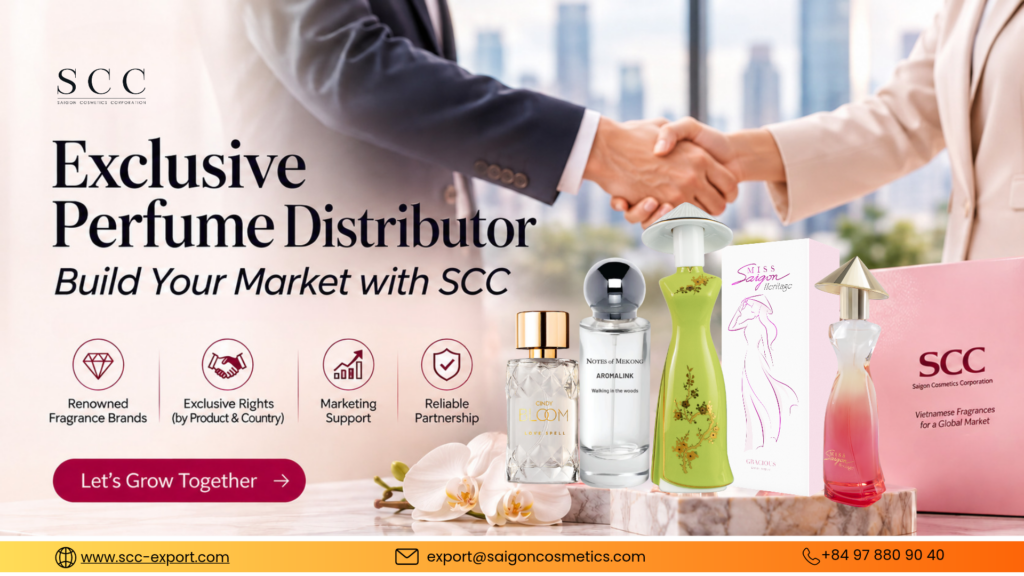
SCC is a perfume manufacturer based in Ho Chi Minh City, with more than 50 years in the industry. The company holds ISO 9001:2015 and CGMP-ASEAN certifications and is registered with the US FDA. SCC has exported to the Philippines and several other ASEAN markets. For a distributor, the relevant point is that SCC already owns a portfolio of brands across several price segments, so the right line can be matched to the right market.

On scope, SCC typically grants exclusivity by product and by country. You may propose exclusive rights to a brand or a group of products in one country, for example a premium women’s fragrance line in a single market, instead of taking the entire range. All SCC products can be considered for this arrangement. At present, none of SCC’s target markets in ASEAN has an exclusive distributor, so a distributor who applies early has a clear advantage in choosing.
A Two-Way Commitment: Sales Targets and Termination
When signing an exclusive agreement for a product or product line, the distributor commits to a sales target or order volume to be taken within the year. The figure is agreed for each product and market, based on the distributor’s sales channels and business plan. If the agreed level is not reached by the end of the period, the contract may be terminated and the remaining matters handled according to the terms both parties have signed.
This mechanism protects both sides. SCC does not leave a market locked up by an inactive partner, and a committed distributor can be confident that no one else will be authorized within the same scope. In practical terms, we suggest setting a commitment you are confident of reaching based on your existing sales data, then increasing it in later periods. A high figure set only to win the rights can create pressure throughout the year.
Support for Exclusive Distributors
An exclusive distributor receives more than product. SCC provides marketing support, including point-of-sale materials (POSM), testers so customers can try the fragrances, and content for online marketplace stores. SCC also supports trademark protection in the distributor’s country, either by handling the process or by working alongside the distributor, so that exclusivity is backed by legal protection locally and not only by the contract. Preferential pricing is also available for exclusive partners. The details of each item are discussed and recorded in the agreement, depending on the product and market.
Order Conditions
For SCC’s existing brands, the minimum order quantity is 200 bottles. On payment, the distributor places a deposit of 80% of the order value so that SCC can begin production, and pays the balance before the goods are loaded onto the truck. This process gives both parties clarity on timing and allows the distributor to plan cash flow for each shipment from the start.
How to Assess an Exclusive Agreement Before Signing
Before submitting a proposal, a distributor should answer three questions. First, which products and countries do you genuinely have the channels to sell in? A scope that is too wide will push the commitment beyond your capacity. Second, what sales volume can you commit to over 12 months, based only on the data you have today? Third, what support do you need from the manufacturer to reach that figure, such as testers, marketplace content or trademark registration? With answers to these three questions, the discussion with SCC can go straight to the terms and avoid time spent clarifying capability.
Frequently Asked Questions
Does SCC grant exclusivity by country?
Yes. Exclusivity is typically agreed by product and by country, and the target markets in ASEAN are currently all open.
What happens if the sales commitment is not met?
The contract may be terminated and handled according to the agreement both parties have signed.
What are the order conditions?
The minimum is 200 bottles for existing brands, with an 80% deposit to begin production and the balance paid before the goods are loaded onto the truck.
Get in Touch
Looking for Fragrance Brands to Distribute? Explore SCC’s ready-made fragrance brands for your market. Tell us about your business, target country and expected order quantity so we can recommend suitable products.
Saigon Cosmetics Corporation (SCC)
Phone: +84 97 880 90 40
Email: export@saigoncosmetics.com
Website: www.scc-export.com