Picture a seller running a perfume store on TikTok Shop and Shopee in Kuala Lumpur. He imports 300 bottles of wholesale perfume he found online. The sample was excellent, but the second batch has a different scent intensity from the first, the packaging deviates from the agreed specification, and when he needs documents to deal with the marketplace or a regulator, the supplier replies slowly or not at all. This is an illustrative scenario, but it will be familiar to anyone who has imported goods. What these orders have in common is that price did not decide the outcome. Choosing the right type of wholesaler did.
This article explains how to tell the different kinds of fragrance wholesaler apart, the criteria for evaluating them, the questions to ask before a first order, the warning signs to watch for, and how to run a trial order to decide whether to continue. The final section shows how far SCC meets these criteria, so you can verify it yourself.
Three types of “fragrance wholesaler” you will meet
In practice, the term fragrance wholesaler covers three different groups, and they work in very different ways. The first is the manufacturer: a company that owns its factory, blends fragrances itself or sources them from fragrance houses, fills the bottles and sells under its own brands. The second is the distributor or trading company, which buys from one or more manufacturers and resells, usually with a broader range. The third is the reseller or marketplace aggregator, who typically sells small quantities with flexibility but rarely has original documentation to back the goods.
| Perfume Manufacturer | Distributor / trading company | Reseller / aggregator | |
|---|---|---|---|
| Source of goods | Own production, own brands | Buys from one or several manufacturers | Buys from distributors or retail |
| Batch control | High, controls the whole process | Depends on the upstream source | Low, hard to trace |
| Range | Focused on its own brands | Usually multi-brand | Varies with what is in stock |
| Documents and certificates | Can supply directly | Must request from the manufacturer | Usually unavailable |
| Best suited to | Importers wanting a stable, long-term source | Sellers needing many brands in small orders | Very small market tests |
No group is automatically right or wrong. The real question is which one fits your plan: selling a few core scents for many months, or rotating through many brands to test trends.
Should you buy wholesale perfume directly from a manufacturer or through an intermediary?
Buying directly from a fragrance manufacturer wholesale has three clear advantages. First, the party answering questions about the formula, the production batch and the shelf life is the one that actually made the product, so there is less room for distorted information. Second, documents such as quality system certificates, ingredient lists and import-support materials can be obtained at the source. Third, when you need to reorder exactly the scent that has been selling well, the manufacturer is the only party that genuinely controls that.
The trade-off is that a manufacturer usually offers only its own brand portfolio and sets minimum order quantities by line. If your strategy is to sell a wide mix of international brands, a multi-brand distributor makes more sense. But if you want to build a stable range to sell on marketplaces over the long term, a direct source usually gives you more control.
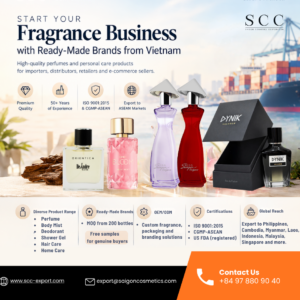
Saigon Cosmetics Corporation (SCC) is a Ho Chi Minh City perfume manufacturer with over 50 years in the industry, selling ready-made perfume brands directly from 200 bottles, with ISO 9001:2015, CGMP-ASEAN and US FDA registration. Buying direct gives better batch and document control; intermediaries suit buyers who need a multi-brand range.
Six criteria for evaluating a fragrance wholesaler
Verifiable capability and certifications
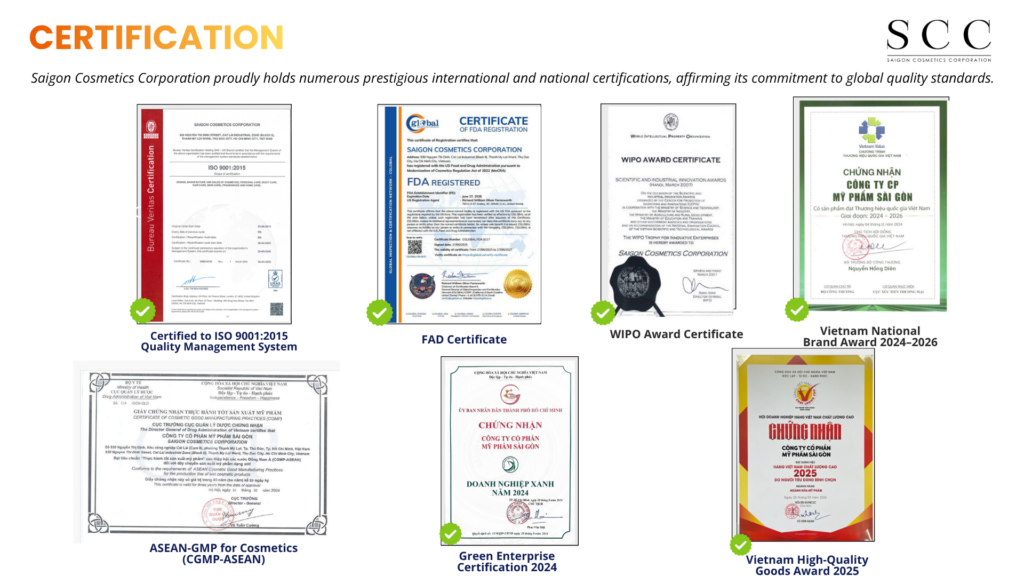
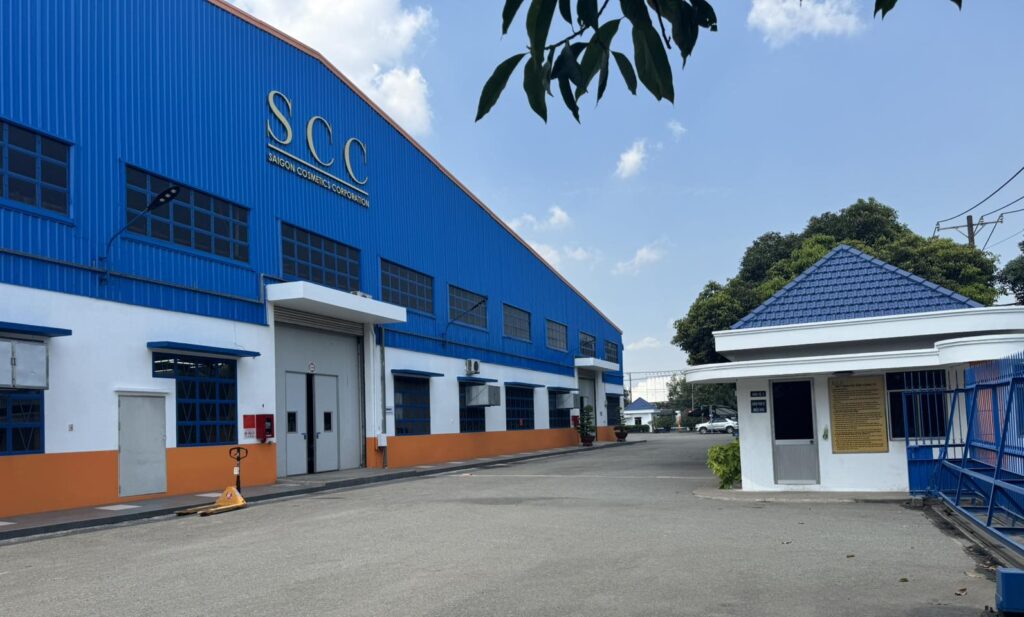
Do not rely on a line such as “internationally certified” on a website. Ask for copies of the certificates, check the legal entity name and validity dates, and see whether the information is consistent across the website, LinkedIn profile and B2B platforms. For a manufacturer, also ask about capacity and factory scale to judge whether it can fulfil repeat orders. For example, SCC operates a 17,000 m² factory at Cat Lai Industrial Park, with about 500 employees, perfume capacity of 400,000 bottles per month, ISO 9001:2015 and CGMP-ASEAN certifications, and US FDA registration.
Brand portfolio and price tiers
An online marketplace seller rarely sells in only one segment. You need a few lead scents that drive sales, a few lower-priced scents that bring in traffic, and some premium scents that raise basket value. So check whether the branded perfume supplier has ready-made brands across price tiers. SCC’s perfume range is listed by tier and carton specification in its published price list, based on Vietnam retail listing prices; it helps you picture the segments and carton packing, and it is not a quotation for a specific order.
Packaging specifications and batch consistency
For marketplace sellers, two batches that differ in scent or packaging are a common cause of low ratings and returns. Ask the supplier about carton specifications, shelf life, how batch codes are marked on the packaging, and how it handles a batch that deviates from the approved sample. A serious supplier will answer with a concrete process, not a generic promise.
Terms of cooperation: MOQ, payment, samples
These three items determine how small you can start. Check whether the MOQ is counted in bottles or cartons, whether it applies per brand or per order, what the payment terms are for new customers, and whether the supplier sends samples. With SCC, ready-made perfume brands have an MOQ from 200 bottles, standard payment is 100%, new customers can pay a 70–80% deposit, and free samples are sent to genuine prospective customers.
Documentation and compliance for the destination market
Each market has its own cosmetics regulator, for example the FDA in the Philippines, NPRA in Malaysia and HSA in Singapore, and requirements for product notification, labelling and ingredients may differ. Alcohol-based perfume is also commonly shipped under separate rules for flammable goods. So ask in advance which documents the supplier can provide (ingredient list, safety documents, manufacturing site certificates), rather than discovering a gap after the goods are on the ship. Importers should still confirm current requirements with the authority in their own country.
Support for selling on online marketplaces
A good supplier does not just deliver goods; it helps them sell. Ask whether it provides images, product content, fragrance notes, testers or display materials. For SCC’s brands, the price list sets out the marketing activation for each brand, such as official brand stores on Shopee, Lazada and TikTok Shop, visual content, and KOL/KOC collaboration for the perfume lines, so a seller knows in advance which assets it can build on.
What should you ask a wholesaler before placing a first order?
Saigon Cosmetics Corporation (SCC) supplies ready-made perfume brands from 200 bottles; new customers can pay an 80% deposit upfront to start production and receive free samples if they are genuine prospects. Before a first order, importers should request a price list, carton specifications, certificate copies (ISO 9001:2015, CGMP-ASEAN, US FDA) and samples.
The table below collects the questions most worth asking. The purpose is not to challenge the supplier, but to see how quickly, clearly and consistently it answers, because that is also how it will work once an order is running.
| Question | Why it matters | What a credible answer looks like |
|---|---|---|
| Are you a manufacturer or an intermediary? | Determines who is responsible for the batch | States the legal entity and factory address, and is ready to provide documents |
| Which certificates are currently valid? | Confirms the production process | Sends copies, with the issuing body and validity dates |
| What are the MOQ and carton specifications? | Lets you size the first-order budget | Specific figures by brand and volume |
| What are the payment terms for new customers? | Affects cash flow | States the deposit percentage and when the balance is due |
| Do you send samples, and under what conditions? | Allows testing before commitment | A clear sample policy, and asks about your market and sales channel |
| What happens if a batch deviates from the sample? | Reduces return risk | Has a process, does not avoid the question |
| Which documents support import into my country? | Avoids problems at customs or on the marketplace | Lists the documents it can provide |
Warning signs when choosing a fragrance wholesaler
Several signals should make you slow down. A price that is unusually low against the market, with no explanation of the source, is the first. The second is a supplier that avoids sending certificates, a factory address or legal entity details. The third is information that does not match across channels: the website says one thing, while the LinkedIn profile or B2B storefront says another. The fourth is the absence of written carton specifications, shelf life or payment terms. Finally, if a supplier does not want to send samples or refuses to discuss your sales plan, it may not be ready for serious B2B work.
A simple check is to cross-reference the supplier across several public channels. For example, SCC has a storefront on Alibaba.com and is among the Top 100 Featured Businesses of the Vietnam Pavilion for 2026–2027, a recognition awarded by the Vietnam Trade Promotion Agency (Ministry of Industry and Trade) and Alibaba.com. This can be checked directly against the scc-export.com website and other official channels.
Run a trial order before committing long term
Once you have shortlisted two or three candidates, do not rush into a large order. Request the catalog, price list and samples, then assess the samples in three layers. The first is the scent: compare what you smell against the product’s fragrance notes (top, middle, base) and test on skin to see how the scent develops after a few hours. The second is packaging: bottle, spray pump, box, label, batch code, and how sturdy the carton is in transit. The third is the accompanying documentation: whether there is enough information to create sales content and to work with a freight forwarder.
If the samples pass, the next step is a trial order at the MOQ level, spread across three to five scents in different segments rather than concentrated in one. Track three indicators: sell-through speed, return or complaint rate, and consistency if you reorder. After one or two sales cycles you will have enough data to decide whether to increase the order, change scents or move to another supplier.
Where SCC fits in this picture
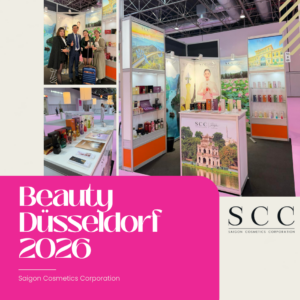
SCC grew out of the Imortel Perfumes France factory (before 1975), became Saigon Cosmetics Corporation in 1999 and a public company in 2007. It has over 50 years in the industry, a distribution network of more than 26,429 active points of sale in Vietnam, and export experience to markets including the Philippines, Malaysia, Singapore, Indonesia, Cambodia, Myanmar, Laos, China and the United States. Fragrance materials are sourced from Robertet, Firmenich and Givaudan.
For importers and online marketplace sellers, the point worth noting is that SCC does not offer perfume alone. It operates in four categories: perfume, personal care, home care, and mother & baby, so an importer can expand the range from a single source instead of working with many suppliers. The brands are all ready-made, so you can place an order and start selling without developing a product.
Looking for Fragrance Brands to Distribute? Explore SCC’s ready-made fragrance brands for your market. Tell us about your business, target country and expected order quantity so we can recommend suitable products.
Saigon Cosmetics Corporation (SCC)
Phone: +84 97 880 90 40
Email: export@saigoncosmetics.com
Website: www.scc-export.com
FAQ
What is a fragrance wholesaler? A fragrance wholesaler is a company that sells perfume in bulk to importers, distributors or resellers. It may be a manufacturer, a trading company or a reseller, and each type offers a different level of batch control, documentation and MOQ.
What is SCC’s MOQ? SCC supplies wholesale perfume from 200 bottles for its ready-made brands. For other product categories, please contact SCC for information based on the latest quotation.
What are the payment terms for new customers? Standard payment is 100%. New customers can pay a 80% deposit of the order value.
What certifications does SCC hold? SCC holds ISO 9001:2015 and CGMP-ASEAN certifications and US FDA registration, with over 50 years of experience in the industry.
Does SCC send free samples? Yes, free samples are sent to genuine prospective customers.
Which product categories does SCC supply? Four categories: perfume, personal care, home care, and mother & baby. See more at scc-export.com