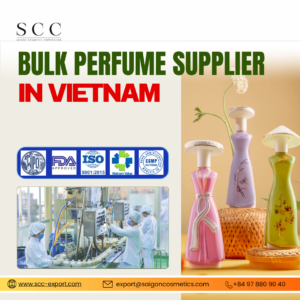
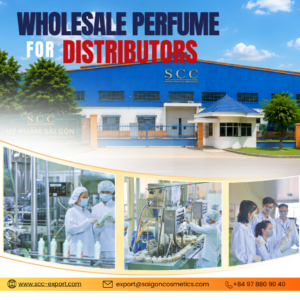
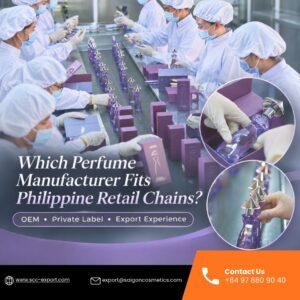
Saigon Cosmetics Corporation (SCC), a Vietnamese cosmetic manufacturer with over 50 years in the industry, supplies distributors with ready-made perfume brands, from Miss Vietnam porcelain editions to mass-market Cindy. Orders start from 200 bottles for existing brands, backed by ISO 9001:2015, CGMP-ASEAN registration.
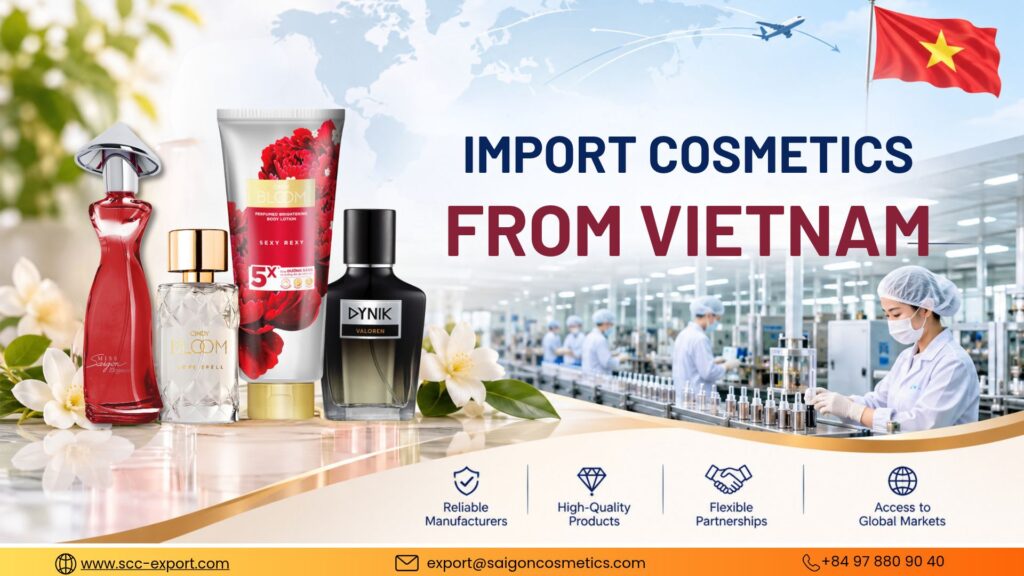
Import cosmetics from Vietnam is becoming an interesting sourcing option for international businesses looking to expand their beauty and personal care product portfolios. From fragrances and perfumes to hair care, body care, and home care products, Vietnam offers opportunities to work with local manufacturers, established beauty brands, and OEM/ODM suppliers.
However, choosing where to source cosmetics involves more than comparing product prices. International importers need to evaluate manufacturing capabilities, product quality, minimum order quantities (MOQs), regulatory compliance, export documentation, and long-term supply reliability.
Whether you are a distributor looking for established Vietnamese beauty brands, a retailer seeking new products, or a business planning to develop your own cosmetics line, understanding the sourcing process is essential before making an investment. This guide explores what international buyers should know before importing cosmetics from Vietnam, including how to select manufacturers, evaluate product categories, calculate import costs, and establish a reliable manufacturing partnership.
Why Source Cosmetics from Vietnam?
Vietnam offers an established manufacturing base for beauty, personal care, and household products. Instead of sourcing every category from a different country, international buyers can explore several product groups through Vietnamese manufacturers.
A Growing Manufacturing Ecosystem
Vietnam has developed manufacturing capabilities across multiple consumer product categories, including:
- Perfumes and fragrance products
- Body care products
- Hair care products
- Facial and skincare products
- Personal hygiene products
- Home care and household cleaning products
For importers, this creates opportunities to expand an existing product portfolio or introduce complementary categories through one sourcing destination.
Access to Multiple Product Segments
International buyers may find products targeting different consumer groups, from everyday personal care to more specialized fragrance and beauty collections. For example, a distributor can consider combining perfumes with body lotions, shower gels, deodorants, shampoos, and other complementary products. This approach can help businesses develop a broader assortment without relying on a single product category.
Opportunities for Regional Trade
Vietnam’s participation in ASEAN trade agreements can offer tariff advantages for qualifying products traded between member countries.
Under the ASEAN Trade in Goods Agreement (ATIGA), eligible goods may benefit from preferential tariff rates, subject to applicable rules of origin and documentation requirements.
Importers should verify the applicable HS code, origin criteria, and destination-country customs requirements before calculating the expected import costs.
What Cosmetics Products Can You Import from Vietnam?
Before contacting cosmetic manufacturers, identify the categories that match your customers and distribution channels.
Below are several product groups worth exploring.
Perfumes and Fragrance Products
Vietnamese manufacturers offer fragrance products in different formats, sizes, and market positions.
Potential product categories include:
- Eau de Parfum
- Women’s and men’s perfumes
- Body mist and hair & body mist
- Perfumed deodorants
For distributors, the selection should reflect local fragrance preferences, target retail prices, packaging expectations, and the positioning of existing brands.
Body Care Products
Body care is a practical category for importers serving cosmetics retailers, supermarkets, and online stores.
Products may include:
- Body lotion
- Shower gel and body wash
- Body scrub
- Hand wash
- Deodorants
- Personal hygiene products
These categories can complement fragrance products and create opportunities for coordinated product collections.
Hair Care Products
Hair care is another category worth considering, particularly for distributors serving beauty stores, supermarkets, and personal care retailers.
Common products include:
- Shampoo
- Conditioner
- Hair masks
- Hair serum
- Anti-dandruff shampoo
- Herbal and botanical hair care products
When evaluating these products, consider local hair care habits, ingredient preferences, product claims, and packaging sizes.
Home Care Products
Some cosmetics manufacturers also operate home care production lines.
Depending on the supplier’s capabilities, importers may explore:
- Room sprays
- Air fresheners
- Scented gels
- Hand wash
- Household cleaning products
A supplier with multiple production categories may offer additional sourcing opportunities for businesses serving both personal care and home care markets.
How to Choose a Reliable Cosmetics Manufacturer in Vietnam
Choosing the right manufacturer is one of the most important decisions in the importing process. A competitive quotation is useful, but it should never be the only factor in your supplier evaluation.

Verify the Actual Manufacturing Facility
Start by determining whether you are communicating directly with a manufacturer or through a trading intermediary.
Ask for:
- Company registration information
- Factory address and production capabilities
- Product categories manufactured in-house
- Quality management certifications
- Relevant manufacturing documentation
- Information about previous export experience
If possible, arrange a factory visit or request a virtual factory tour.
A direct relationship with the manufacturer can make communication about product specifications, quality issues, production schedules, and repeat orders more straightforward.
Review Quality Management Standards
Cosmetics manufacturers should have documented quality management and manufacturing procedures appropriate to their product categories.
Depending on the manufacturer and product type, relevant standards may include:
- ISO 9001: Quality management systems
- CGMP-ASEAN: ASEAN cosmetic good manufacturing practices
Do not assume that a factory certification automatically means every product is approved for sale in your destination country.
Product compliance and local market authorization must be evaluated separately.
Evaluate Product Samples
Never make a purchasing decision based solely on catalogue images or descriptions. Request samples and evaluate the actual products. For fragrance products, consider scent characteristics, packaging, spray performance, and consistency. For skincare and personal care products, review texture, fragrance, appearance, packaging functionality, and the product information provided by the manufacturer. Sample evaluation helps your purchasing team identify potential issues before committing to a larger order.
Understand Production and Supply Capabilities
A manufacturer may have attractive products but limited capacity for your expected purchasing volume.
Discuss the following:
- Minimum order quantity (MOQ)
- Production lead time
- Available packaging formats
- Repeat-order planning
- Quality control procedures
- Carton specifications
- Export packaging standards
Clear expectations at the beginning can help prevent delays and misunderstandings later.
What Documents Do You Need When Importing Cosmetics?
Documentation is an essential part of international cosmetics trade. The exact requirements depend on the product category, destination country, customs classification, and local regulatory framework. Before placing an order, ask the manufacturer which documents are available and consult your local customs broker or regulatory specialist about what is required.
Commercial and Shipping Documents
Common international trade documents may include:
Commercial Invoice
Shows the transaction details, including seller, buyer, product description, quantities, unit prices, and total value.
Packing List
Provides information about the shipment’s packaging, carton quantities, gross weight, net weight, and dimensions.
Bill of Lading or Air Waybill
Serves as the transport document for sea or air shipments.
Certificate of Origin (C/O)
May be required to establish the origin of the goods and support preferential tariff claims where applicable.
Product and Regulatory Documents
Depending on the product and importing country, buyers may also need to review:
- Product ingredient list or INCI list
- Product specifications
- Certificate of Analysis (COA), where applicable
- Safety Data Sheet (SDS), where applicable
- Product safety or stability test information
- Good Manufacturing Practice documentation
- Free Sale Certificate, if required
- Product notification or registration documentation
Not every document applies to every cosmetic product. Some documents must be prepared by the manufacturer, while others may need to be obtained or submitted by the importer or its authorized local representative.
Check Product Registration Before Shipment
This is particularly important for businesses importing cosmetics into regulated markets.
For example, cosmetic products placed on the market in ASEAN countries are generally subject to the applicable ASEAN Cosmetic Directive framework and national implementation requirements.
In the Philippines, cosmetic notification requirements are administered by the Food and Drug Administration (FDA) Philippines.
In other markets, the relevant authority and procedures may differ.
Importers should confirm:
- Whether the product category is regulated as a cosmetic.
- Whether local product notification or registration is required.
- Who is responsible for submitting the required information.
- Which ingredient restrictions and labeling rules apply.
- Whether the product claims are acceptable in the destination market.
Do not assume that a manufacturer’s existing certificates replace local cosmetic notification requirements.
How Much Does It Cost to Import Cosmetics from Vietnam?
The total import cost involves more than the manufacturer’s quoted product price.
To understand the actual investment, calculate the landed cost of the shipment.
Main Cost Components
| Cost component | What to consider |
|---|---|
| Product price | Unit price and order quantity |
| Packaging | Bottles, labels, cartons and protective materials |
| Inland transportation | Factory to port or airport |
| International freight | Sea or air transportation |
| Insurance | Cargo insurance, where applicable |
| Customs duties | Based on HS code, origin and destination |
| Import taxes | VAT or other applicable taxes |
| Customs clearance | Brokerage and handling fees |
| Local delivery | Port or airport to your warehouse |
The final cost depends on the selected product, shipment volume, destination, transport method, applicable trade agreements, and agreed Incoterms.
Understand FOB and CIF Pricing
When comparing quotations from Vietnamese manufacturers, make sure you understand the shipping terms.
FOB (Free On Board)
Under FOB, the seller handles the agreed export-side responsibilities until the goods are loaded on board the nominated vessel at the named port. The buyer generally arranges and pays for the main international freight and subsequent costs.
CIF (Cost, Insurance and Freight)
Under CIF, the seller arranges and pays for the cost, insurance, and freight to the named destination port. Import customs clearance, duties, and subsequent delivery are generally the buyer’s responsibility.
Always confirm the named port and the applicable Incoterms version in the quotation or sales contract.
Calculate the Landed Cost Per Unit
A simple calculation can help you evaluate whether the products are commercially suitable.
Landed cost per unit = Total import-related costs ÷ Total sellable units received.
After calculating the landed cost, compare it with your expected wholesale perfume or retail selling price.
Remember to include local distribution costs, marketplace commissions, marketing expenses, and your target profit margin when building the final pricing model.
How to Place Your First Cosmetics Order from Vietnam
For first-time importers, a structured purchasing process can make supplier evaluation easier.
Step 1: Define Your Target Market
Identify the country where you intend to sell the products.
Different markets have different consumer preferences, product registration procedures, ingredient restrictions, labeling rules, and import requirements.
Step 2: Select Product Categories
Choose the products that match your existing distribution network.
For example, a cosmetics distributor may begin with body care and fragrance products, while a supermarket supplier may prefer a wider assortment covering hair care, personal hygiene, and home care.
Step 3: Contact Suitable Manufacturers
Provide your company information, target market, preferred categories, and estimated purchasing quantity.
This allows manufacturers to assess your requirements and recommend relevant products.
Step 4: Request Samples and Documentation
Evaluate the products and review the available technical and quality documents.
At this stage, clarify whether any additional testing, product adaptation, or packaging changes are required for your market.
Step 5: Confirm MOQ, Pricing and Shipping Terms
Request a detailed quotation covering product specifications, quantities, packaging, lead times, payment terms, and applicable Incoterms.
Compare suppliers based on total commercial value rather than unit price alone.
Step 6: Confirm Regulatory Requirements
Before production or shipment, work with your local regulatory specialist or customs broker to confirm product compliance and import documentation.
This step is particularly important when introducing a new product category or importing cosmetics into a market for the first time.
Step 7: Arrange Shipment and Follow Up
Once the order is confirmed and production is completed, coordinate shipping documents, freight arrangements, customs clearance, and final delivery.
Maintain communication with the manufacturer throughout the process to ensure that the shipment matches the agreed specifications.
Sourcing Cosmetics from Saigon Cosmetics Corporation (SCC), Vietnam
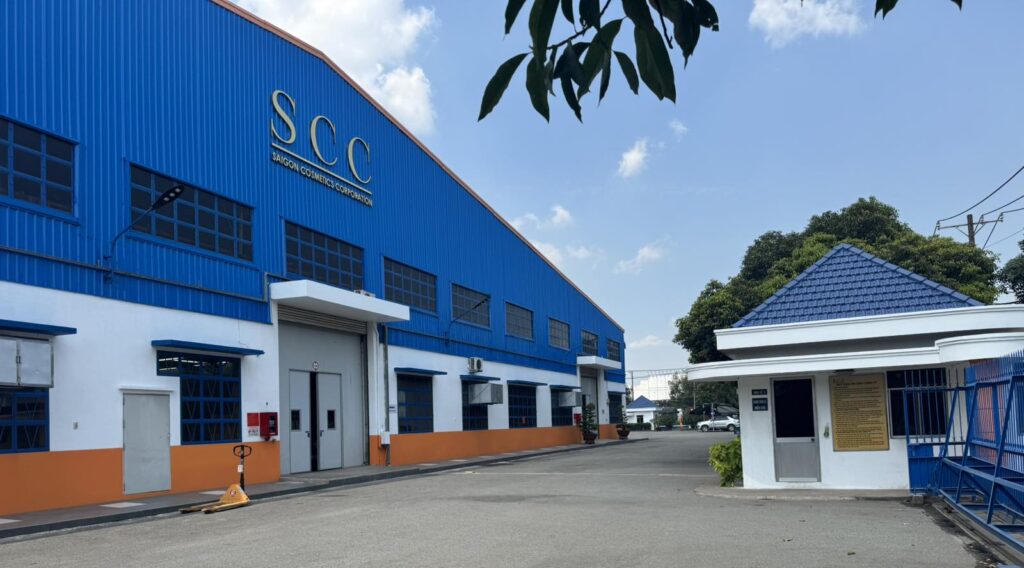
For international businesses looking to import cosmetics from Vietnam, Saigon Cosmetics Corporation (SCC) is perfume manufacturer offers a combination of fragrance, personal care, hair care, and home care manufacturing capabilities. Established in 1999, SCC has a manufacturing history rooted in the Vietnamese fragrance industry dating back before 1975. The company operates a 17,000 m² facility in Cat Lai Industrial Park, Ho Chi Minh City, and employs more than 500 people.
Multiple Product Categories from One Manufacturer
SCC develops and manufactures several product categories under its own brands.
Fragrance Products
- Miss Saigon
- Miss Vietnam
- Cindy Bloom
- Cindy
- DYNIK
- DeAndre
- Notes of Mekong
Body Care Products
- Body lotion
- Shower gel
- Body scrub
- Roll-on deodorant
- Hair and body mist
Hair Care Products
- Shampoo
- Conditioner
- Hair masks
- Herbal and botanical hair care products
Home Care Products
- Room sprays
- Scented products
- Selected household care products
For importers, this range creates opportunities to explore multiple categories through one manufacturing partner rather than managing separate supplier relationships for every product group.
Manufacturing Standards and Quality Management
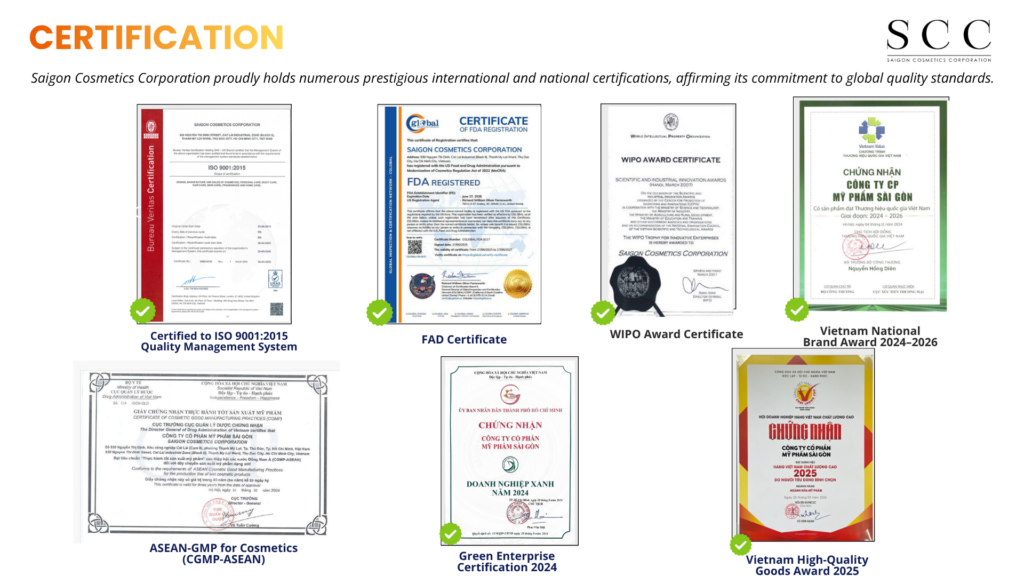
SCC’s manufacturing operations are supported by:
- ISO 9001:2015 Quality Management System
- CGMP-ASEAN Certification
These provide international buyers with important information when evaluating SCC’s manufacturing and quality management capabilities.
Product-specific documentation and destination-market requirements can be discussed with the export team.
Own Brands and OEM/ODM Cooperation
SCC prioritizes its own fragrance and personal care brands, allowing distributors and importers to explore ready-made products with established brand identities.
For businesses with specific product concepts, SCC also welcomes discussions about suitable OEM/ODM and private-label projects.
The available cooperation model, MOQ, product specifications, and development requirements depend on the selected category and project scope.
Export Experience and International Cooperation
SCC has experience supplying international markets, including the Philippines, Cambodia, China, Malaysia, Singapore, and other destinations.
Our export team works with international buyers to discuss product selection, commercial terms, samples, documentation, and shipment arrangements.
We understand that each market has different purchasing and regulatory requirements, which is why product recommendations and export arrangements should be discussed according to the buyer’s destination and business model.
What Should You Prepare Before Contacting a Vietnamese Cosmetics Manufacturer?
To receive a more relevant quotation and avoid unnecessary back-and-forth communication, prepare the following information:
Company Information
- Company name and country
- Business type: importer, distributor, wholesaler, or retailer
- Website or existing sales channels
Product Requirements
- Preferred product categories
- Target customer segment
- Required product specifications
- Packaging and branding preferences
Purchasing Requirements
- Estimated initial order quantity
- Expected purchasing frequency
- Target price range, if available
- Preferred shipping terms
Market Requirements
- Destination country
- Applicable product registration requirements
- Required certificates and technical documents
The more specific your inquiry, the easier it is for the manufacturer to assess product suitability and provide a useful quotation.
Frequently Asked Questions About Importing Cosmetics from Vietnam
Is Vietnam a good country to source cosmetics?
Vietnam is an established manufacturing destination for fragrance, personal care, hair care, and home care products. Buyers should evaluate individual manufacturers based on factory capabilities, product quality, documentation, and export experience.
What cosmetics products can I import from Vietnam?
Depending on the manufacturer, buyers can source perfumes, body lotions, shower gels, shampoos, conditioners, deodorants, body mists, and selected home care products.
Do Vietnamese cosmetics manufacturers provide OEM and private-label services?
Yes. Some manufacturers offer OEM, ODM, and private-label services, allowing international businesses to develop products under their own brands. MOQ, development scope, and available customization depend on the manufacturer and product category.
What documents are required to import cosmetics from Vietnam?
Common trade documents include a commercial invoice, packing list, and bill of lading or air waybill. Depending on the destination market and product, additional documents such as ingredient lists, product specifications, COA, SDS, GMP documentation, and product notification information may be required.
Can I import cosmetics from Vietnam to the Philippines?
Yes, subject to applicable Philippine import and cosmetic regulatory requirements. Importers should check the relevant FDA Philippines requirements, including cosmetic product notification, labeling, and other applicable documentation before placing products on the market.
Can I import different cosmetic categories from one Vietnamese manufacturer?
Yes, if the manufacturer has production capabilities across those categories. Working with one supplier for perfume, body care, hair care, and home care can simplify supplier communication and purchasing coordination.
Looking for a Cosmetics Manufacturer in Vietnam?
Choosing the right manufacturing partner is an important step toward building a reliable cosmetics supply chain.
Whether you are an importer looking for ready-made brands, a distributor expanding your product portfolio, or a business developing its own private-label products, Saigon Cosmetics Corporation (SCC) welcomes inquiries from international partners.
Tell us about your business, target market, preferred product categories, and estimated order quantity. Our export team will help you explore suitable products and discuss the next steps.
Contact Saigon Cosmetics Corporation (SCC)
Phone: +84 97 880 90 40
Email: export@saigoncosmetics.com
Website: www.scc-export.com