If you’re sourcing perfume from Vietnam for the first time, perfume manufacturer certifications are probably the fastest way to separate a real factory from a trading company reselling goods made elsewhere. But not every certificate on a supplier’s website means the same thing. Some are issued by independent auditors. Others are self-declared, or awarded by industry associations with looser standards. Before you sign an OEM contract or place a bulk order, it’s worth knowing exactly what to ask for — and why.
Why certifications matter more than they seem to
A distributor or OEM partner is putting their own brand name behind a product they didn’t manufacture. If something goes wrong — a formulation that doesn’t meet import regulations, a batch that fails quality control, a factory that can’t scale past a pilot order — the cost lands on the buyer, not just the factory. Certifications are the paper trail that lets you check a supplier’s claims against something other than their own marketing.
The trouble is, “certified” is a word suppliers use loosely. A useful certification has three things: it’s issued by a recognized third party, it covers a specific and relevant scope, and it’s current, not something earned five years ago and never renewed. Here’s what to actually look for.
Quality management: ISO 9001
ISO 9001 certifies that a factory has a documented, repeatabl
e quality management system — not that every bottle is perfect, but that there’s a consistent process behind production, and that process is reviewed. Ask which version the supplier holds (ISO 9001:2015 is current) and who audited it. A certification from a well-known international auditor like Bureau Veritas, SGS, or TÜV carries more weight than one from an unnamed local body, simply because those auditors have their own reputations on the line.
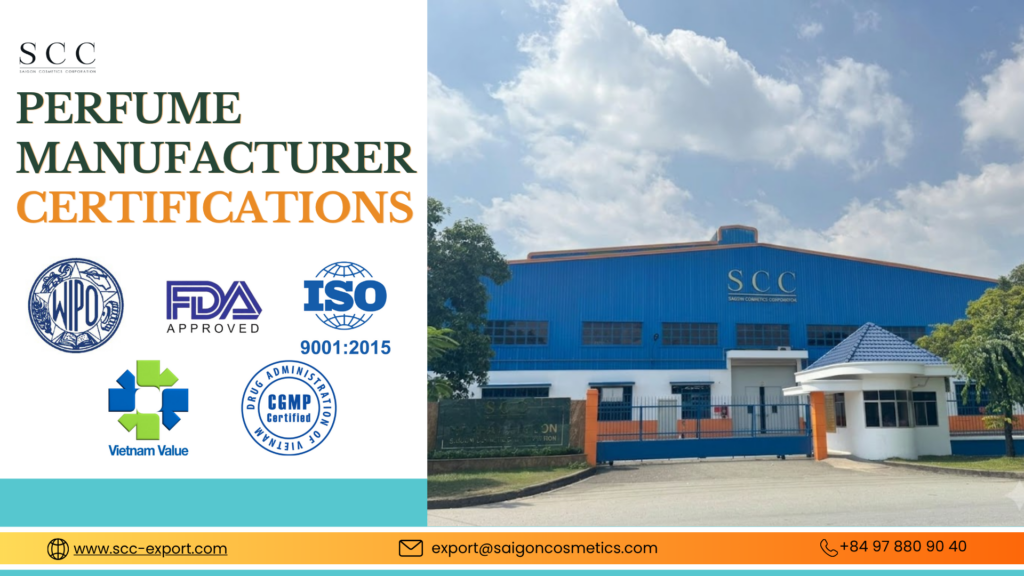
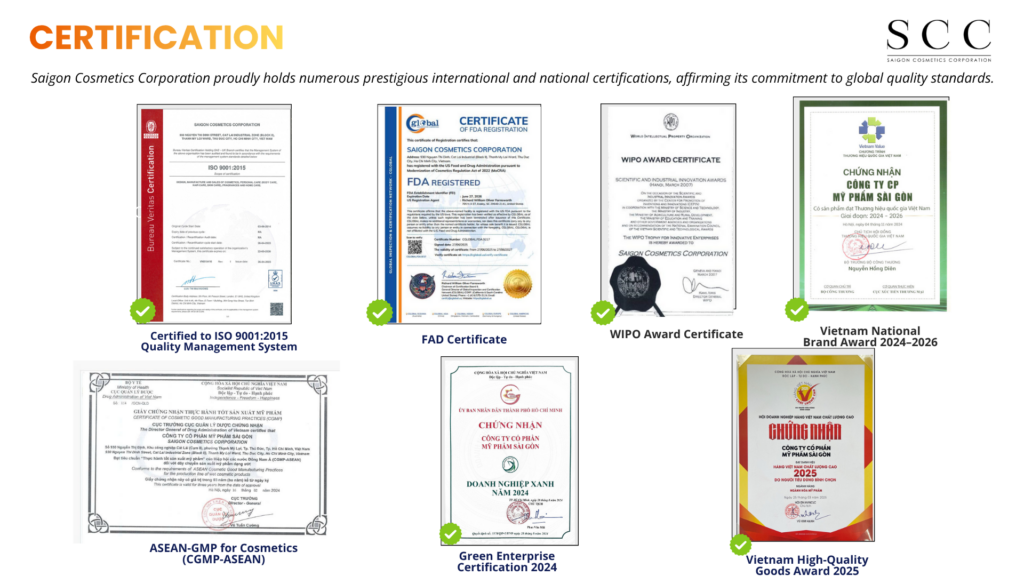
Saigon Cosmetics Corporation (SCC) holds ISO 9001:2015 certification audited by Bureau Veritas.
Manufacturing practice for cosmetics: CGMP-ASEAN
CGMP-ASEAN (Cosmetic Good Manufacturing Practice) is the regional standard for how cosmetics and personal care products — including perfume — should be produced, stored, and handled. It’s a more product-specific standard than ISO 9001, covering things like facility hygiene, ingredient traceability, and staff training. For a Philippine or Thai distributor, this matters because ASEAN-wide GMP compliance is often what your own market’s regulators will ask about when you register imported cosmetics locally.
SCC is CGMP-ASEAN certified.
Market access certifications: US FDA registration
If a factory exports to the United States, it needs to be registered with the US FDA under cosmetic facility registration requirements. This isn’t a quality award — it’s a regulatory requirement — but it’s a useful signal anyway. A factory that has gone through FDA registration has already had to meet documentation and traceability standards that many smaller manufacturers never bother with, because the process forces a level of operational discipline that pays off across other markets too.
SCC holds US FDA registration.
Government and national recognition
Beyond international standards, it’s worth checking whether a perfume manufacturer has been recognized by its own government or by verified national industry bodies. In Vietnam, the Vietnam National Brand Award is a government-backed recognition (under the Ministry of Industry and Trade) given to companies that meet criteria on quality, innovation, and sustainable capacity — it’s not something a company can simply apply for and buy.
SCC has held the Vietnam National Brand Award for the 2024–2026 cycle, along with the Vietnam High-Quality Goods Award for 18 consecutive years, the Vietnam Golden Star Award, and a WIPO Award Certificate recognizing intellectual property capability.
These awards don’t replace ISO or GMP certification — they don’t test a factory’s production line — but a long, unbroken record of national recognition is hard to fake and worth factoring into your due diligence, especially alongside the harder technical certifications above.
Sustainability certification
Increasingly, buyers — especially retail chains and modern trade partners — ask about environmental compliance before listing a product. A Green Enterprise Certification, issued by provincial or national environmental authorities, indicates a factory meets defined standards on waste management, emissions, and resource use, rather than just claiming to be “eco-friendly” in its marketing copy.
SCC received Green Enterprise Certification in 2024.
A quick checklist before you commit
When you’re evaluating perfume manufacturer certifications, ask for documentation — not just a logo on a website — for each of the following:
- ISO 9001 — who audited it, and when was it last renewed
- CGMP-ASEAN — confirms the facility follows cosmetic-specific manufacturing practice
- FDA registration — required if any of your target markets include the US, or if you want proof the factory can meet strict documentation standards
- National or government awards — a useful supporting signal, not a substitute for the above
- Environmental or sustainability certification — increasingly relevant for retail partners with ESG requirement
A factory that can produce documentation for all five, from named third-party or government bodies, is operating at a different level than one that lists vague “quality assured” badges with no auditor named. It’s a five-minute question to ask — and it can save months of trouble later if the answer turns out to be thin.
About Saigon Cosmetics Corporation
Saigon Cosmetics Corporation (SCC) is a Vietnamese fragrance and personal care manufacturer based in Cat Lai Industrial Park, Ho Chi Minh City. The company’s roots go back to a French-owned perfume factory (Imortel Perfumes) that was nationalized in 1975, re-established as a state-run factory in 1990, and restructured into Saigon Cosmetics Corporation in 1999. SCC has operated as a public company since 2007.
Today SCC runs a 17,000 m² facility, including roughly 6,000 m² of production space, with a workforce of around 500 people. Monthly output capacity includes 400,000 perfume bottles, 200,000 aerosol bottles, 300,000 liters of shampoo and shower products, and 1.8 million sachets, alongside soap production.

On certifications specifically — the subject of this article — SCC holds ISO 9001:2015 (audited by Bureau Veritas), CGMP-ASEAN, and US FDA registration. The company has also received the Vietnam National Brand Award for 2024–2026, the Vietnam High-Quality Goods Award for 18 consecutive years, the Vietnam Golden Star Award, a WIPO Award Certificate, and Green Enterprise Certification in 2024.
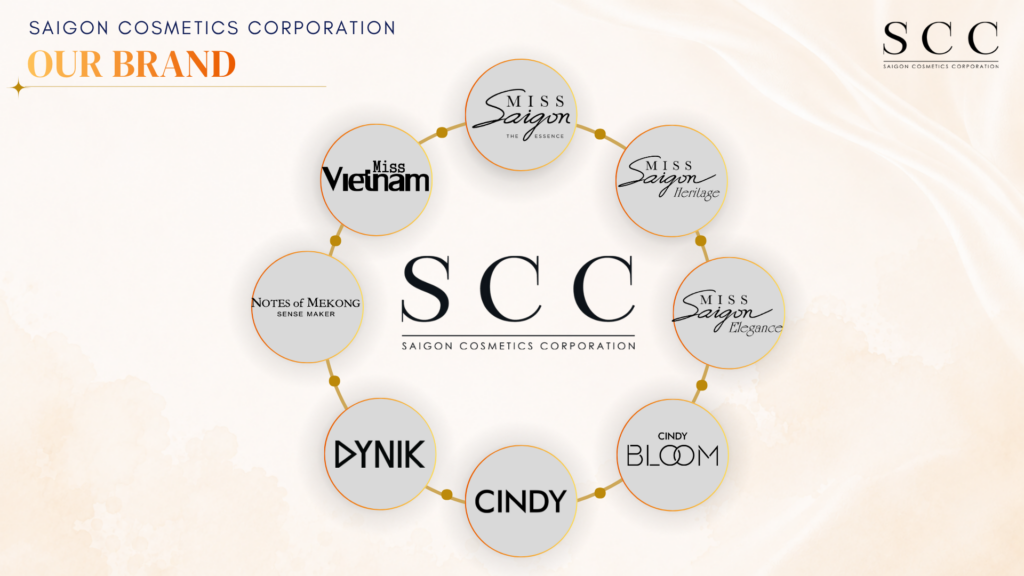
SCC’s own brand portfolio includes Miss Saigon — recognized as a Vietnam National Brand for 2024–2026, known for its “áo dài” and “nón lá”-inspired bottle designs — alongside Miss Vietnam, Cindy Bloom, Cindy, Notes of Mekong, Dynik, Spring, Fresh, Kleen, and Pure Air, covering fragrance, hair and body care, and home care. Beyond its own brands, SCC manufactures for OEM and private label partners, sourcing fragrance oils through partnerships with Robertet, Firmenich, and Givaudan, and distributes through more than 26,000 points of sale in Vietnam plus export markets including the Philippines, the United States, China, Indonesia, Malaysia, and Singapore.
For certification documentation or manufacturing inquiries, contact
Saigon Cosmetics Corporation (SCC) Cat Lai Industrial Park, Ho Chi Minh City, Vietnam
Phone: +84 97 880 90 40
Email: export@saigoncosmetics.com
Website: www.scc-export.com