Finding a perfume manufacturer you can confidently build your business around is much harder.
For importers, distributors, wholesalers, retailers, and emerging fragrance brands, choosing a manufacturing partner involves much more than comparing product prices. The right supplier needs to deliver consistent quality, meet regulatory requirements, support your target market, and provide enough flexibility for your business to grow.
A manufacturer may offer an attractive price but have a high MOQ. Another may have excellent products but limited export experience. A third may offer private label services but lack the production capacity to support your business after the first successful launch.
So, how should you compare them? Before choosing a perfume manufacturer, focus on these 5 key areas:
- Real manufacturing capability
- Quality control and regulatory compliance
- MOQ, product options, and business model
- Export experience and market support
- Total cost, not just unit price
This checklist can help you move beyond a supplier’s sales pitch and evaluate whether they are the right long-term partner for your market.
Verify the Manufacturer’s Real Production Capability
The first question to ask is simple:
Are you actually the manufacturer?
The answer matters because the company you contact may not always be the company producing your perfume. In the fragrance industry, international buyers may encounter several types of suppliers:
- Direct manufacturers
- Trading companies
- Distributors
- Contract manufacturers
- Sourcing agents
- Companies combining manufacturing and trading activities
There is nothing inherently wrong with working with a trading company. However, buyers should understand who controls the actual production process before placing a large order.
A direct manufacturer can potentially provide greater visibility into production, quality control, lead times, customization, and capacity.
What should you check?
Don’t stop at a supplier’s website saying “factory” or “manufacturer.”
Ask specific questions:
- Where is your manufacturing facility?
- How large is the facility?
- What products are manufactured there?
- Which production processes are handled in-house?
- What is your monthly production capacity?
- How many employees work in production?
- Can you provide factory certifications?
- Can I arrange a factory visit or virtual factory tour?
- Can you show your production and quality-control processes?
The more specific the answers, the easier it is to evaluate the manufacturer’s actual capability.
Why production capacity matters
Production capacity becomes particularly important when your first order succeeds.
Imagine you import 1,000 bottles to test your market. The product performs well, and you suddenly need 5,000, 10,000, or 50,000 bottles for your next orders.
A supplier that can handle only small batches may become a bottleneck.
A reliable manufacturing partner should therefore be able to support both your initial order and your potential growth.
Look for evidence, not adjectives
Words such as:
“Large factory”
“Professional manufacturer”
“Advanced technology”
“High production capacity”
are easy to put on a website.
Instead, look for measurable information:
Factory size + production capacity + manufacturing categories + certifications + export history
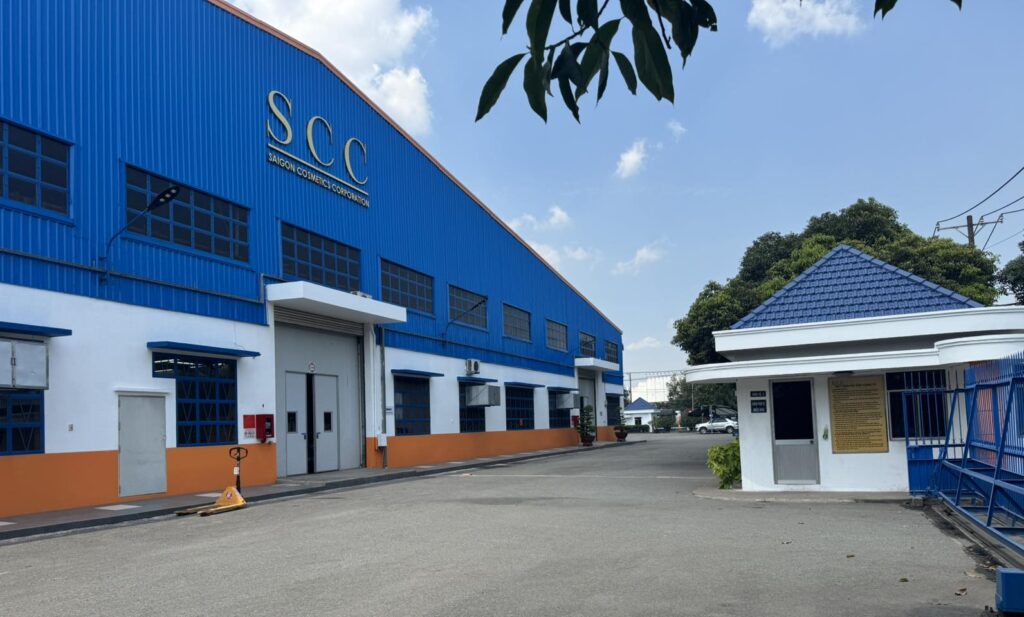
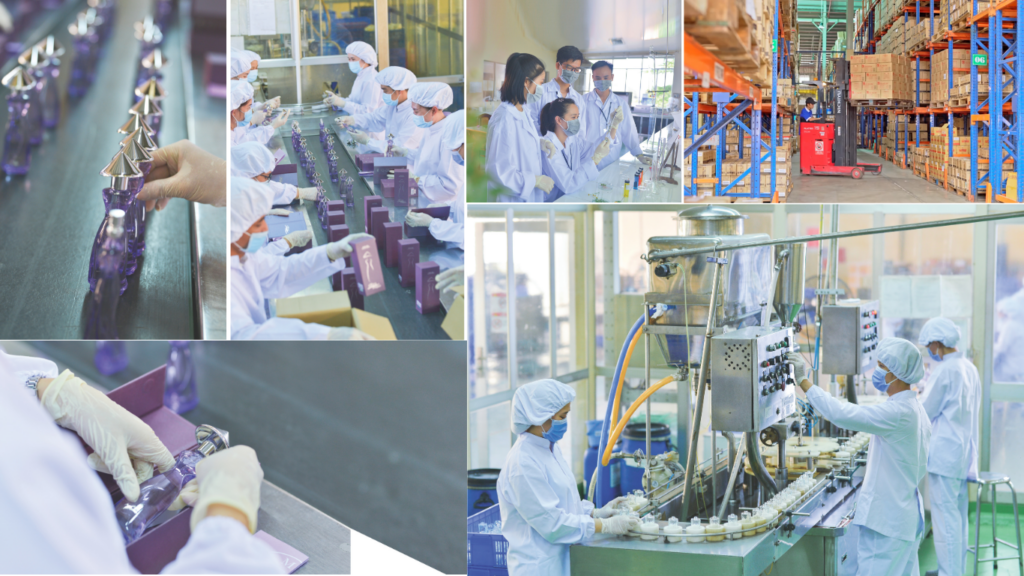
For example, Saigon Cosmetics Corporation (SCC) operates a 17,000 m² facility in Cat Lai Industrial Park, Ho Chi Minh City, including approximately 6,000 m² of production area. Its reported monthly perfume production capacity exceeds 400,000 bottles.
This type of information gives buyers something concrete to evaluate.
Questions to ask before moving forward
☐ Is this company the actual manufacturer?
☐ Can I verify its factory?
☐ What is its production capacity?
☐ What products are manufactured in-house?
☐ Can it scale production if my sales increase?
If a supplier cannot provide clear answers to these questions, investigate further before making a commitment.
Check Quality Control and Regulatory Compliance
A perfume may look beautiful and smell excellent, but international buyers need to evaluate something deeper:
Can the manufacturer consistently produce a safe, compliant, and specification-controlled product?
This is where quality management and regulatory compliance become critical.
A serious perfume manufacturer should have standardized processes covering areas such as:
Raw materials → formulation → compounding → filling → packaging → inspection → finished goods
The objective is not simply to produce a good first batch.
It is to produce a product that remains consistent from batch to batch.
Don’t just ask: “Are you certified?”
Ask what the certification actually means.
For example:
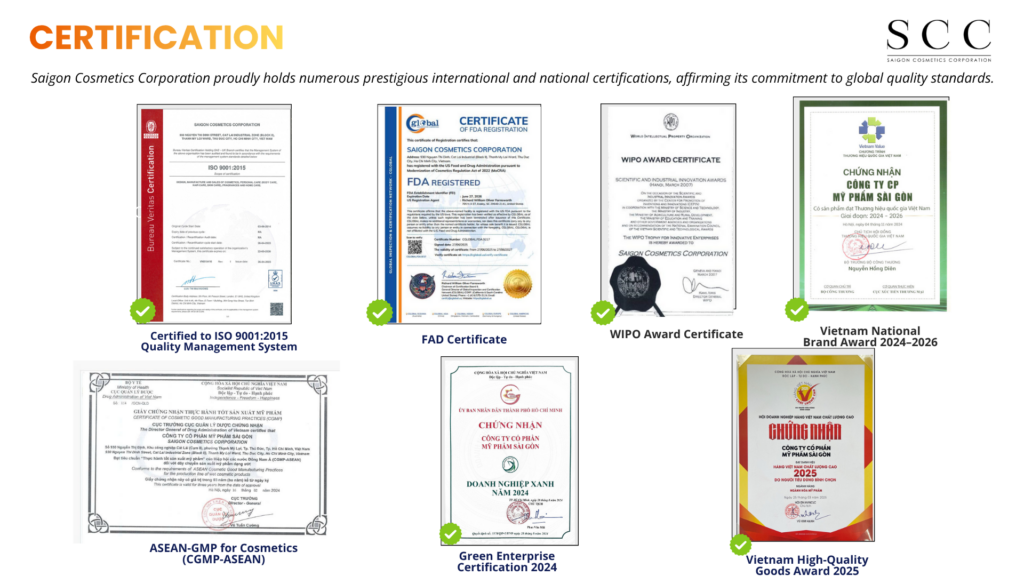
ISO 9001
ISO 9001 relates to quality management systems. For a buyer, it can indicate that the manufacturer has established processes for managing and continually improving quality.
CGMP / ASEAN Cosmetic GMP
Good Manufacturing Practice is particularly relevant to cosmetics and personal care production. It addresses controlled manufacturing practices, hygiene, quality systems, documentation, and related production controls.
Market-specific requirements
Your target country may also require additional documentation or product compliance procedures.
Depending on the product and destination market, buyers may need documents such as:
- Certificate of Analysis (COA)
- Safety Data Sheet (SDS/MSDS)
- Certificate of Free Sale (CFS)
- Product specifications
- Ingredient information
- Manufacturing information
- Product registration or notification documents
- Export documentation
The exact requirements vary by market, so the manufacturer should be able to discuss what documentation it can provide for your destination.
Why this matters for importers
Imagine discovering after production that a document required by your market is unavailable.
The problem is no longer simply “the supplier forgot a document.”
It could affect:
- Customs clearance
- Product registration
- Import timelines
- Additional costs
- Product launch schedules
This is why compliance should be checked before the purchase order, not after the goods are produced.
Also check batch consistency
For perfume, quality is not only about regulatory documentation.
Ask how the manufacturer controls consistency between batches.
Useful questions include:
How do you ensure fragrance consistency between production batches?
How are raw materials checked?
Is each batch traceable?
What quality checks are performed before shipment?
Can you provide a COA for the finished product?
A reliable manufacturer should be able to explain its quality-control process clearly rather than simply saying:
“Our products are high quality.”
A practical example: SCC
SCC’s manufacturing operations are supported by ISO 9001:2015 and CGMP-ASEAN, and the company also has US FDA registration. SCC’s export documentation support includes documents such as COA and MSDS, depending on project and destination-market requirements.
For an importer, the important point is not simply that certificates exist.
The real question is:
Can the manufacturer’s quality system and documentation support my product when it enters my market?
Before choosing a manufacturer, check:
☐ Current and verifiable certifications
☐ Quality-control procedures
☐ Batch traceability
☐ Product specifications
☐ COA / SDS/MSDS availability
☐ Market-specific regulatory support
☐ Clear process for handling quality issues
Evaluate MOQ, Product Options, and the Business Model
One of the biggest mistakes new perfume importers make is looking at MOQ and unit price separately.
They should be considered together.
A supplier may quote an attractive price per bottle but require 10,000 or 20,000 units per SKU.
For a new importer, that can create significant inventory risk.
Start with your market, not the manufacturer’s MOQ
Before asking:
“What is your MOQ?”
ask yourself:
“How much product do I realistically need to test my market?”
For example, a new distributor may want to test:
- 2–3 fragrances
- 500–1,000 units per SKU
- One retail channel
- One geographic market
An established distributor may instead need:
- Multiple fragrances
- Thousands of units per SKU
- Regular monthly replenishment
- Exclusive distribution
- Custom packaging
The right MOQ depends on your business stage.
What determines perfume MOQ?
MOQ can vary depending on:
- Existing or custom fragrance
- Number of SKUs
- Bottle type
- Packaging
- Label customization
- Box printing
- Custom bottle molds
- Formula development
- Production complexity
This is why asking only:
“What’s your lowest MOQ?”
doesn’t give you the full picture.
Ask:
“What is the MOQ for the specific product and business model I am considering?”
Understand the different sourcing models
Before choosing a manufacturer, understand which model actually fits your business.
Option 1: Ready-to-Market Brand
You purchase and distribute an existing perfume brand.
This can be suitable for importers who want to enter the market quickly without developing a new brand from scratch.
Option 2: Private Label
You use an existing fragrance or product base and sell it under your own branding, subject to the manufacturer’s available customization options.
This can reduce development time compared with creating an entirely new formula.
Option 3: OEM / Custom Development
You work with the manufacturer to develop a product based on your specifications, potentially including fragrance, packaging, bottle, and branding.
This offers more control but generally requires more development work and may involve higher MOQs.
There is no universally “best” model
The right question is:
Which model gives my business the best balance between differentiation, investment, speed, and risk?
For some distributors, importing an established fragrance brand is the smarter first step.
For others, private label makes more sense.
For an established company with a clear brand strategy, custom OEM development may be the better long-term solution.
Why MOQ flexibility matters
For new importers, flexible MOQ can make market testing less risky.
SCC currently offers MOQ starting from 1,000 bottles for selected perfume wholesale and OEM projects, although actual MOQ depends on the product and project requirements.
That flexibility can allow a buyer to test market demand before committing to significantly larger inventory.
And once a product proves successful, the next question becomes:
Can the same manufacturer scale with me?
That’s where MOQ and production capacity need to be evaluated together.
Before choosing your supplier, ask:
☐ What is the MOQ per SKU?
☐ Can I mix different fragrances in one order?
☐ What changes if I customize packaging?
☐ Can I start with existing products before developing a custom formula?
☐ What happens to MOQ when my order volume increases?
☐ Can the manufacturer scale production after the market test?
Check Export Experience and Ability to Support Your Market
A manufacturer can produce excellent perfume and still be the wrong supplier for your business.
Why?
Because manufacturing a product and exporting a product are two different capabilities.
International buyers need a supplier that understands what happens after production.
That includes:
Documentation → labeling → packing → shipping → customs → import requirements → replenishment
Ask where they already export
A useful starting question is:
“Which countries do you currently export to?”
But don’t stop there.
Ask:
- Have you exported to my country?
- Have you worked with distributors before?
- Do you understand my market’s product requirements?
- Can you provide export documentation?
- Can you support product registration or notification documents where applicable?
- What is the typical lead time?
- How do you handle shipping and logistics?
- Can you support repeat orders?
A manufacturer with experience across different markets is more likely to understand that one product specification does not necessarily work everywhere.
Market fit matters as much as manufacturing
A fragrance that performs well in Vietnam may not automatically perform well in the Philippines, Japan, Europe, or the Middle East.
Consumer preferences can differ in:
- Fragrance intensity
- Product format
- Price positioning
- Packaging
- Bottle size
- Gender positioning
- Seasonal demand
- Shopping behavior
A manufacturer with international experience can therefore bring more value than simply producing whatever product specification the buyer sends.
Look for a manufacturer that can support the business, not just the shipment
For an importer, useful support may include:
- Product recommendations
- Sample development
- Packaging consultation
- Documentation
- Export procedures
- Production planning
- Reorder management
- Product portfolio expansion
SCC currently reports exports across 10+ international markets, including markets in Southeast Asia, China, and the United States.
That experience is relevant because international fragrance sourcing involves more than putting finished bottles into a container.
Before choosing a manufacturer, ask:
☐ Which countries do you currently export to?
☐ Have you worked with distributors or importers like my company?
☐ Can you support the documents required in my market?
☐ Can you advise on product and packaging requirements?
☐ What is your typical production lead time?
☐ How do you handle repeat orders and supply planning?
Compare the Total Cost — Not Just the Unit Price
This may be the most important commercial lesson for a new importer:
The lowest factory price does not always mean the lowest sourcing cost.
When comparing perfume manufacturers, buyers often create a simple table:
| Supplier | Price per bottle |
|---|---|
| Supplier A | $3.00 |
| Supplier B | $3.20 |
| Supplier C | $3.40 |
And immediately choose Supplier A.
But the real calculation is more complicated.
Your actual sourcing cost may include:
Product cost + packaging + customization + samples + documentation + freight + insurance + import duties/taxes + local logistics + inventory cost
This is your total landed cost.
Example
Imagine:
Manufacturer A
- Lower unit price
- MOQ: 10,000 units
- Higher packaging cost
- Longer lead time
Manufacturer B
- Slightly higher unit price
- MOQ: 2,000 units
- More flexible packaging
- Shorter lead time
For a new importer, Manufacturer B could potentially be the better business decision because you don’t need to invest as much capital in inventory before validating demand.
Don’t forget the cost of slow-moving inventory
Inventory is not free.
If you import 10,000 bottles but only sell 3,000, the remaining 7,000 bottles represent capital tied up in stock.
That can affect:
- Cash flow
- Storage
- Promotions
- Discounting
- Product freshness
- Ability to launch new products
This is why MOQ should be considered as a business-risk factor, not simply a purchasing requirement.
Ask for the complete quotation
When requesting a quotation, clarify:
- Unit price
- MOQ
- Packaging cost
- Customization cost
- Sample cost
- Documentation fees
- Lead time
- Payment terms
- Shipping terms
- Reorder conditions
And most importantly:
“What costs should I expect before the products arrive in my country?”
How SCC Fits These 5 Criteria
For buyers looking for a perfume manufacturer in Vietnam, SCC offers a combination of manufacturing, fragrance development, existing brands, and export capabilities.
Real manufacturing capability
SCC operates its own manufacturing facility in Cat Lai Industrial Park, Ho Chi Minh City, with 17,000 m² of total facility space and approximately 6,000 m² of production area. Its reported perfume production capacity exceeds 400,000 bottles per month.
Quality and compliance
SCC’s manufacturing system includes ISO 9001:2015 and CGMP-ASEAN, and the company also holds US FDA registration. Its export operations support documentation such as COA and MSDS, depending on the product and destination market.
Flexible business models
SCC supports multiple fragrance business models, including wholesale, brand distribution, OEM, ODM, and private label, allowing buyers to choose between existing products and customized development.
International experience
SCC reports export experience across more than 10 international markets, giving its export team experience with different market requirements and international trade processes.
Scalable partnership
SCC’s manufacturing capacity allows buyers to begin with market testing and potentially scale production as demand grows. For selected perfume projects, MOQ can start from 1,000 bottles, with the actual requirement depending on product and customization.
For buyers who are still deciding between distributing an established fragrance brand and developing their own private label, this flexibility can be particularly useful.
Looking for a perfume manufacturer for your market?
Share your target country, product category, estimated order volume, and preferred business model with the SCC Export Team to discuss suitable fragrance products and sourcing options.
Contact SCC’s export team at:
Phone: +84 97 880 90 40
Email: export@saigoncosmetics.com
Website: www.scc-export.com