Picture a seller in Manila who has been selling perfume on TikTok Shop for more than a year. Orders come in steadily, but the stock comes from an intermediary trading company: prices can change from one batch to the next, fast-selling scents run out without warning, and when customers ask where a product comes from, the seller has no confident answer. To grow, this seller needs two things: a stable supply and a product range clear enough to build a shop around. That is also the real problem behind the keyword “perfume business”. This article walks through the decisions an importer or distributor has to make, from choosing how to source and selecting product lines, to working out startup capital and margin, assessing suppliers, clarifying import requirements and placing a first order.
If you want to scale a fragrance business with products you source directly, Saigon Cosmetics Corporation (SCC) is a manufacturer to consider. It has more than 50 years in perfume and cosmetics manufacturing and exports to more than 10 markets.
Two Ways to Source Stock for a Perfume Business: Through an Intermediary or Directly From the Manufacturer
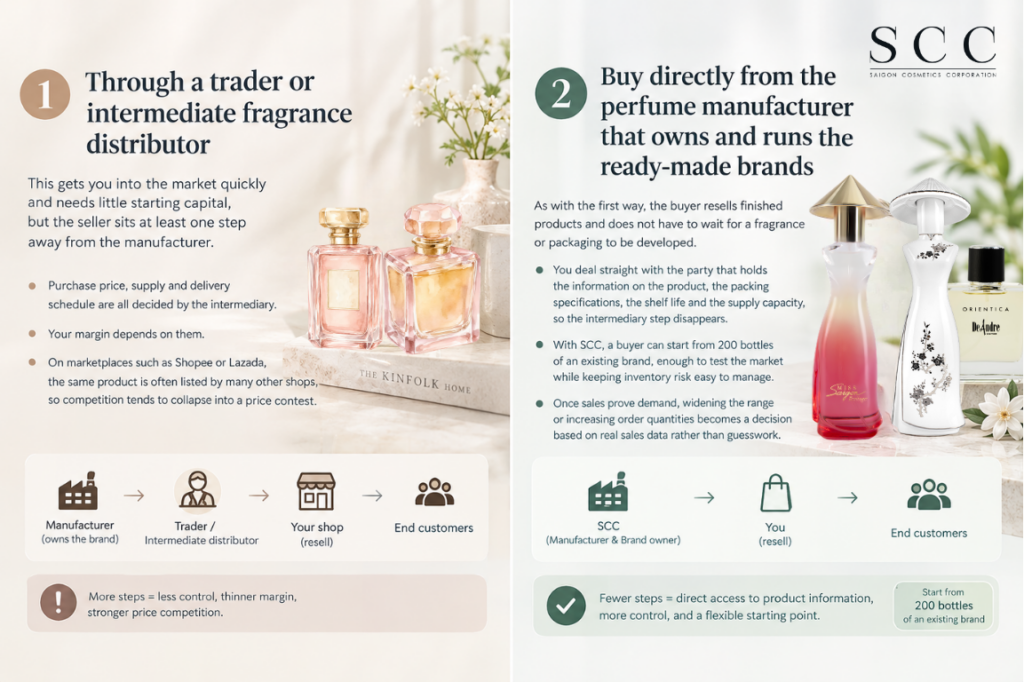
The first way to run a perfume business is to buy products from several brands through a trader or an intermediate fragrance distributor and resell them. This gets you into the market quickly and needs little starting capital, but the seller sits at least one step away from the manufacturer. Purchase price, supply and delivery schedule are all decided by the intermediary, your margin depends on them, and on marketplaces such as Shopee or Lazada the same product is often listed by many other shops, so competition tends to collapse into a price contest.
The second way is to buy directly from the perfume manufacturer that owns and runs the ready-made brands. As with the first way, the buyer resells finished products and does not have to wait for a fragrance or packaging to be developed. The difference is that the buyer deals straight with the party that holds the information on the product, the packing specifications, the shelf life and the supply capacity, so the intermediary step disappears. With SCC, a buyer can start from 200 bottles of an existing brand, enough to test the market while keeping inventory risk easy to manage. Once sales prove demand, widening the range or increasing order quantities becomes a decision based on real sales data rather than guesswork.
| Item | Buying through an intermediary | Buying directly from SCC |
|---|---|---|
| Source of goods | A trader or distributor handling several brands | The manufacturer that owns the brands |
| Purchase price and delivery schedule | Decided by the intermediary | Handled directly, on a quotation at FOB Ho Chi Minh City |
| Product information (fragrance notes, packing specifications, shelf life) | Depends on whether the intermediary provides it | Included in SCC’s quotation and company profile |
| Minimum order | Varies by seller | From 200 bottles of an existing brand |
| Payment | Varies by seller | Standard 100%; new customers may pay a 70–80% deposit |
| Samples | Varies by seller | Free for genuine prospective buyers |
Choosing Product Lines for Your Perfume Business: Start From Your End Customer, Not From the Catalogue
The most common mistake in the early stage of a perfume business is importing too many items in order to “have enough choice”. A wide range where each item sells only a few bottles ties capital up in stock and makes it hard to write sales content deep enough for each product. A more practical approach is to pick two or three lines, each serving a clearly defined group of customers, and then widen the range according to sales data.
Before you commit, check your choice against your own data, such as marketplace search terms, existing orders and customer feedback.
Startup Capital, Margin and Cash Flow: Work From Landed Cost, Not From Gut Feeling
Many newcomers calculate a perfume business by taking the purchase price and adding an arbitrary profit, and only discover the gap when the goods have already arrived in the warehouse. A more reliable method starts from the cost of the goods delivered to your warehouse (landed cost): the FOB price plus freight, insurance, import duty and VAT, customs clearance fees and storage fees. SCC quotes at FOB Ho Chi Minh City, which means the costs after the port of loading are calculated by the buyer for their own market. That is why you should ask a local freight forwarder or customs agent before fixing your selling price.
Capital for a first order can be estimated with a simple framework: the total number of bottles you plan to import multiplied by the average landed cost per bottle, plus a budget for product images and test advertising, plus a reserve for exchange-rate and freight movements. Because stock that arrives without sales content does not generate revenue, the spend on content and test advertising should be counted from the start, not after the goods have already arrived.
Real margin in a perfume business is what remains after all costs are deducted from the selling price, not the difference between the selling price and the purchase price.
On payment, SCC’s standard condition is 100% of the order value. For new customers, SCC supports a 70–80% deposit, so the buyer does not have to pay the full amount up front on the first order. Treat the first order as a test order: enough volume to measure sales speed and feedback before increasing quantities.
How to Assess a Perfume Supplier Before Your First Order
When the source of goods is in another country, you cannot visit the factory every time you need to check something, so documents and verifiable facts are your main tools. There are five things to ask a supplier to make clear.
First, certifications.
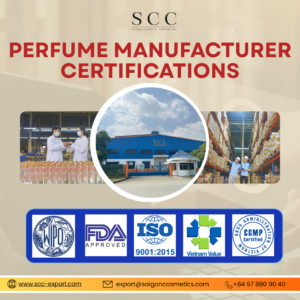
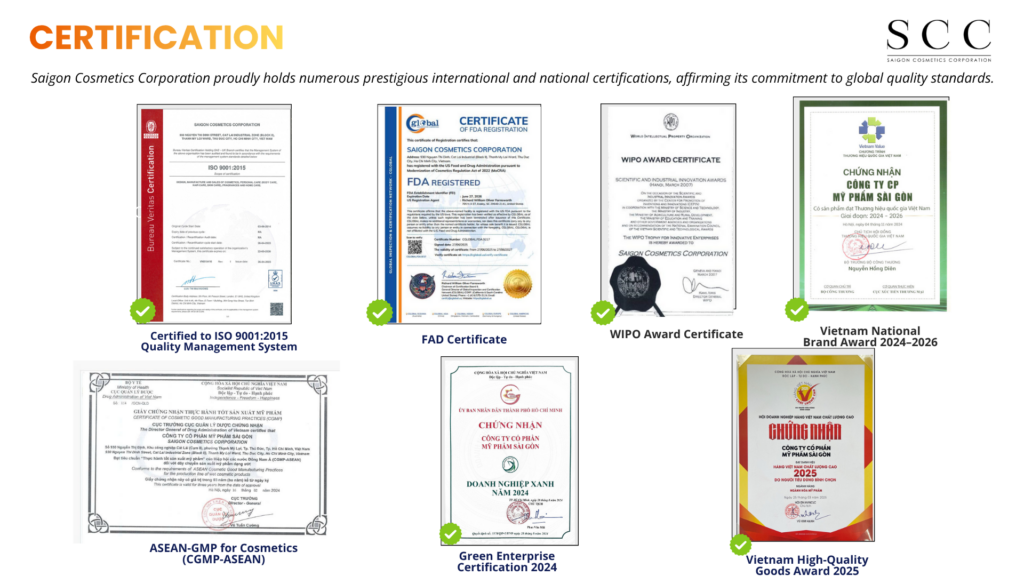
Ask for copies and check the issuing body. SCC holds ISO 9001:2015 certification issued by Bureau Veritas, is CGMP-ASEAN certified and has a US FDA registration.
Second, production capacity against your forecast.
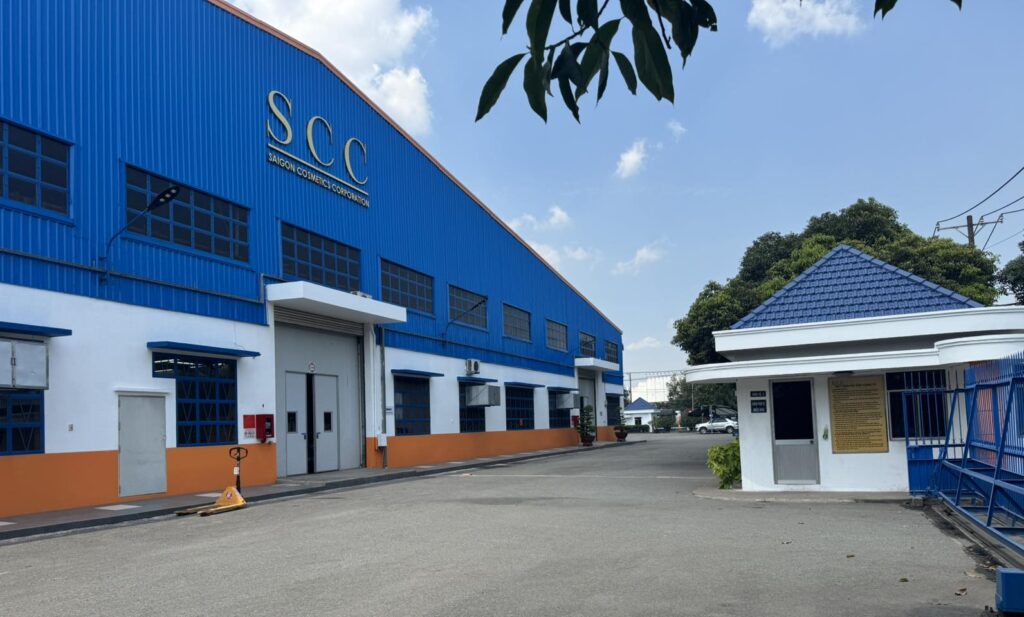
SCC produces about 400,000 bottles of perfume a month at its plant in Cat Lai Industrial Park, Ho Chi Minh City, which covers 17,000 m². This tells you that the orders of a growing importer are not a capacity problem.
Third, fragrance sourcing.
SCC uses fragrance materials from Robertet, Firmenich and Givaudan, international fragrance suppliers confirmed in its company profile.
Fourth, real export history.
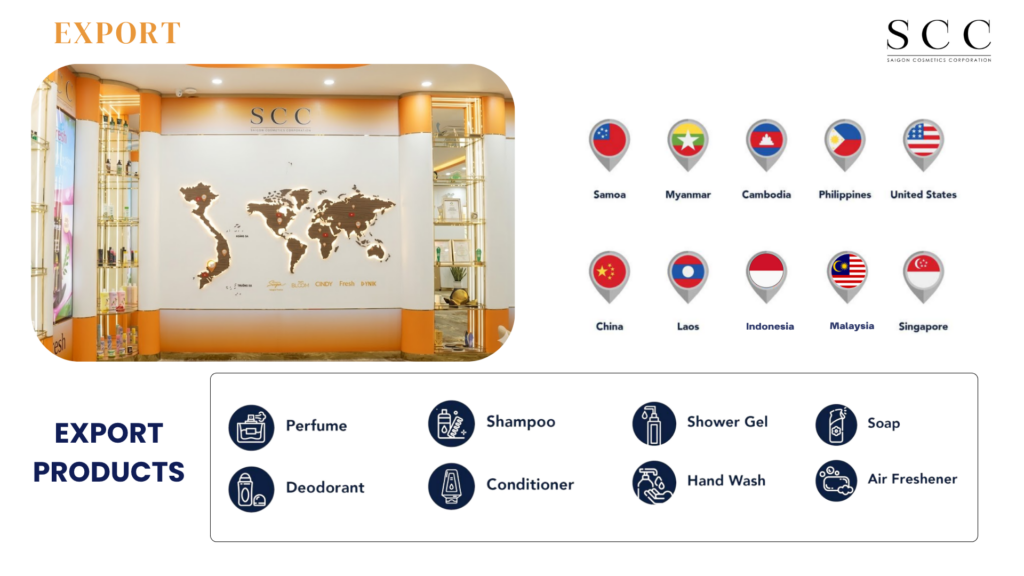
SCC has exported to the Philippines, Cambodia, Myanmar, Laos, Indonesia, Malaysia, Singapore and other markets, so it is used to the documentation and packing requirements of international orders.
Fifth, and most important, samples.
Samples show you the real quality of the scent, how long it lasts, the packaging and how the goods are packed. SCC provides free samples to genuine prospective buyers, so test samples before committing to a quantity.
Import Procedures and Legal Requirements: What to Clarify Before the Goods Leave Port
Perfume and cosmetics are usually regulated separately in each importing country, and the rules in the Philippines differ from those in Thailand. A general checklist usually covers the following: a business registration or licence suited to import activity in your country; notification or registration of the product with the cosmetics regulator where the country requires it; labelling in the local language and under local labelling rules; import duty and VAT; and the shipping and customs documents.
Because the exact requirements differ by country and change over time, before placing an order you should confirm the current requirements with the regulator or a customs agent in your own country, and ask the supplier early which documents they can provide to support your filing. This takes a little time at the start, but it avoids the situation where goods have arrived at port without meeting the conditions for clearance. The content of this article is for reference only and is not a substitute for legal advice.
Turning Scent Into Sales Content on TikTok Shop, Shopee and Lazada
Customers cannot smell a product when they buy online, so an online perfume business depends on a product page that does that job with words and images. The most useful information is the fragrance notes: top, middle and base. Most SCC lines already come with this data; for example, a light white-floral scent will be described and positioned differently from a warm woody one. Write descriptions in the buyer’s language, such as whether a scent suits the office or a night out and which size is easy to carry, and avoid absolute claims you cannot prove. This is honest with customers and also helps your product page stand out from shops that simply copy ready-made descriptions.
From First Contact to Your First Shipment
Starting a perfume business with SCC usually follows five steps. You send an inquiry stating your market, your sales channel and the product lines you are interested in; the more specific the information, the more easily SCC can tell you are a genuine prospective buyer. Next, SCC sends free samples to eligible customers. After testing the samples and assessing feedback, you confirm your first order on the FOB Ho Chi Minh City quotation. Once the goods are on sale, you measure sales speed for each item. Finally, you reorder the items that sell well and consider widening the range.
SCC at a Glance: Over 50 Years in Fragrance and Personal Care Manufacturing
Saigon Cosmetics Corporation (SCC) is a Ho Chi Minh City perfume manufacturer with over 50 years in the industry, about 500 employees and a 17,000 m² plant in Cat Lai Industrial Park. Its perfume capacity is about 400,000 bottles a month, and it holds ISO 9001:2015 and CGMP-ASEAN certifications and a US FDA registration.
1. Manufacturing infrastructure and standards
SCC’s production works to international management and manufacturing standards:
- CGMP-ASEAN standard: production under the CGMP-ASEAN standard.
- ISO 9001:2015 certification: the quality management system is certified to ISO 9001:2015 by Bureau Veritas.
- Fragrance sourcing: SCC sources fragrance materials from Robertet, Firmenich and Givaudan.
2. A portfolio from higher-tier to mass-market lines
SCC’s perfume range runs from higher-tier to mass-market lines:
- Higher-tier lines: Miss Vietnam (35ml, porcelain bottles by Minh Long) and Miss Saigon (50ml, in The Essence, The Elegance and Heritage ranges), with notes ranging from floral and fruity to woody and oriental.
- Mid-range and mass-market lines: Cindy Bloom, Cindy, Dynik, DeAndre and Fantasy, in sizes from 9ml to 100ml.
Partner with SCC Today
Expanding your inventory or launching a private label fragrance line is seamless when partnering with the right manufacturer. Contact our export team today to buy perfumes wholesale prices directly from the source.
Phone: +84 97 880 90 40
Email: export@saigoncosmetics.com
Website: www.scc-export.com