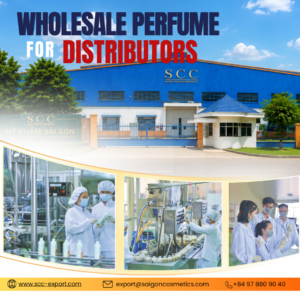
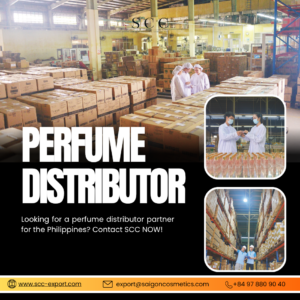
Philippine distributors and importers looking for wholesale perfume suppliers in the Philippines increasingly face the same question: which overseas supplier can actually deliver consistent quality, manageable order sizes, and a fair landing cost — without the risks that come with an unverified factory.
The Philippines fragrance market is growing quickly, and buyers now have more wholesale perfume suppliers to choose from than ever: established names in China and South Korea, legacy European houses, and a newer wave of manufacturers from Vietnam. Choosing the right one isn’t just about unit price. It comes down to a handful of concrete factors that determine whether a partnership actually works past the first order.
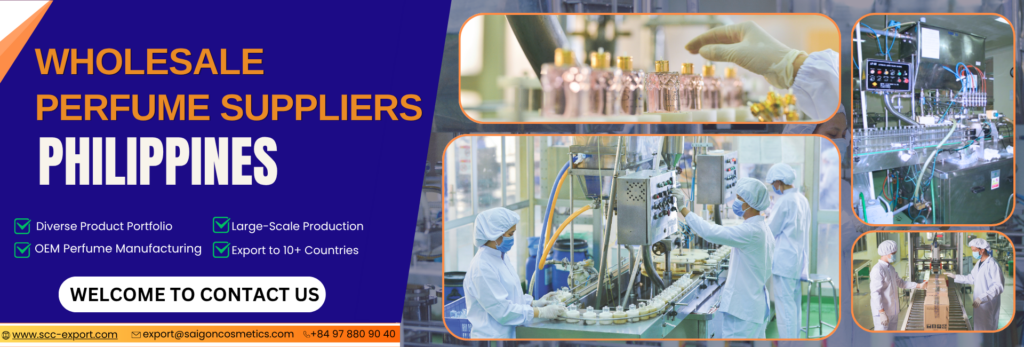
What to Check Before Signing With Any Wholesale Perfume Suppliers
Most Philippine distributors we talk to have been burned once already — a supplier looked fine on paper, then the first shipment came in with inconsistent scent batches, or a certificate that turned out to be expired, or a MOQ that quietly doubled once the contract was signed. So before comparing quotations, it’s worth actually verifying a few things rather than taking a supplier’s word for them.
Manufacturing certifications.
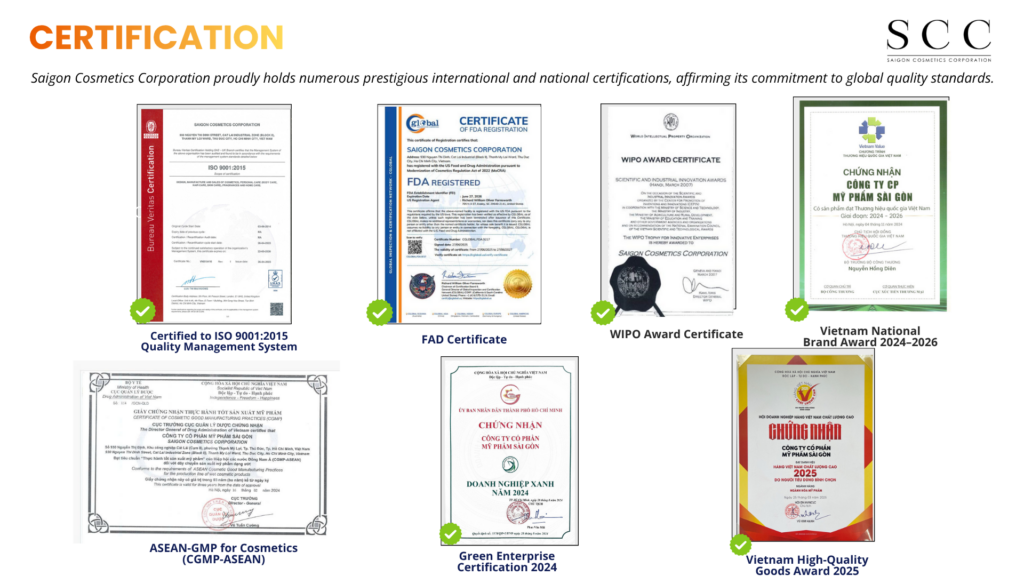
CGMP-ASEAN is the minimum bar for any fragrance or personal care product entering the ASEAN market legally. But a supplier saying “we’re CGMP-certified” means nothing until you’ve seen the actual certificate, checked the certificate number against the issuing body’s registry, and confirmed it hasn’t expired. The same goes for ISO 9001:2015 — ask which certification body issued it (Bureau Veritas, SGS, TÜV, etc.) and request the certificate PDF directly, not a screenshot on a website. If a supplier also has US FDA registration, that’s a useful additional signal — it means their facility has gone through a separate layer of scrutiny beyond what’s required just to sell regionally.
A quick way to sniff out a supplier cutting corners: they hesitate, stall, or send you a certificate with a blurry seal when you ask for the original document.
Minimum order quantity (MOQ) flexibility.
Every new supplier relationship carries risk for both sides, but the importer usually carries more of it, since you’re the one holding inventory if the product doesn’t move. A supplier who’s willing to start with a smaller trial order — rather than insisting on a large minimum from the first purchase order — is signaling they’re confident enough in the product to let you test the market first. Get the MOQ, and any tiered pricing that kicks in at higher volumes, written into the quotation itself, not just discussed verbally. This protects you if the relationship grows and pricing conversations come up later.
Tariff
The unit price quoted by a supplier is only part of the real cost. You need to add freight, insurance, customs duty, and any local taxes to know what a bottle actually costs once it’s sitting in your warehouse. This is where sourcing from Vietnam has a structural advantage: under the ASEAN Trade in Goods Agreement (ATIGA), fragrance products manufactured in Vietnam and imported into the Philippines can qualify for a 0% preferential tariff, provided the supplier can issue a Certificate of Origin (Form D) confirming ASEAN origin.
Compare that to sourcing from South Korea or China, where standard MFN tariff rates apply on top of the unit price. On a full container, that tariff difference alone can be worth more than any discount a supplier offers on price.
Production capacity and OEM Perfume Solutions
If the plan is simply to resell an existing product line under the supplier’s own brand, most manufacturers can support that with minimal friction. But if the goal is to build a private label — your own bottle design, your own brand name, your own formulation preferences — you need a supplier with actual OEM/ODM development capability, not just filling and packing.
Ask to see examples of private label work they’ve done for other clients, and ask how long formulation development typically takes before a product is ready to ship. This timeline matters if you’re planning a launch around a specific date.
How the Buying Process Actually Works, Step by Step
For anyone doing this for the first time, here’s roughly how a first order with a wholesale perfume suppliers Philippine tends to go:
Step 1: Send a detailed RFQ, not a vague inquiry. “Do you export to the Philippines?” gets a generic reply. A request that specifies product type, target price range, expected order volume, and whether you need private label gets a real quotation back — and tells you fast whether a supplier is set up to handle serious buyers.
Step 2: Request samples before requesting a contract. Any supplier worth working with will send samples, usually at your cost for shipping. Test them for scent consistency across bottles if possible, not just one sample — batch-to-batch consistency is one of the most common failure points with fragrance manufacturing.
Step 3: Confirm certificates and Certificate of Origin eligibility before you negotiate price. There’s no point negotiating hard on unit cost if the shipment ends up stuck at customs because the paperwork wasn’t in order, or if you end up paying full tariff because the supplier couldn’t issue Form D.
Step 4: Agree on MOQ, payment terms, and lead time in writing. Standard practice is a deposit (commonly 30%) on order confirmation, with the balance due before shipment or against shipping documents. Lead time from confirmed order to shipment for fragrance products typically runs several weeks, depending on whether it’s an existing formulation or a new private label development.
Step 5: Clarify shipping terms (FOB, CIF, etc.) and who’s responsible for what. If this is your first import from Vietnam, working with a freight forwarder who already handles Vietnam–Philippines routes will save time and prevent costly missteps on documentation.
Step 6: Place the trial order, and use it to evaluate the supplier — not just the product. How they communicate during production, whether they flag problems proactively, whether the shipment arrives when promised — this tells you more about whether it’s worth scaling the relationship than the first quotation ever could.
Why Vietnam Is Emerging as a Sourcing Option for Philippine Buyers
Vietnam’s fragrance manufacturing sector has expanded significantly in recent years, driven by lower production costs relative to more established sourcing markets and growing compliance with international certification standards — which is why more wholesale perfume suppliers from Vietnam are now showing up on Philippine buyers’ shortlists. For Philippine buyers specifically, Vietnam offers three practical advantages over more traditional sourcing markets:
Saigon Cosmetics Corporation is one of the wholesale perfume suppliers in the Philippines’ current sourcing landscape worth a closer look — a Vietnam-based fragrance and personal care manufacturer that has been operating since before 1975, formally established as SCC in 1999. The company operates a 17,000m² manufacturing facility in Ho Chi Minh City with a monthly production capacity of approximately 400,000 perfume bottles.
- Geographic proximity within ASEAN, which shortens shipping times compared to sourcing from outside the region
- ATIGA tariff preference, lowering landed cost relative to non-ASEAN suppliers
- Growing OEM/ODM infrastructure, allowing distributors to develop private label lines without the minimum volumes typically required by larger legacy manufacturers
Saigon Cosmetics Corporation (SCC): A Vietnam-Based Option Worth Evaluating
Saigon Cosmetics Corporation – Wholesale Perfume Suppliers for Philippines is a Vietnam-based fragrance and personal care manufacturer that has been operating since before 1975, formally established as SCC in 1999. The company operates a 17,000m² manufacturing facility in Ho Chi Minh City with a monthly production capacity of over 400,000 perfume bottles.
SCC’s Current Fragrance Portfolio
SCC doesn’t manufacture a single generic perfume line — the portfolio is split across a few distinct brands, each aimed at a different shelf and a different buyer, which matters if you’re trying to figure out where a product would actually sit in your own distribution channel.
Miss Vietnam sits at the top of the range, a luxury line packaged in Minh Long porcelain bottles — the kind of positioning suited to duty-free, gifting, or premium retail rather than mass-market shelf space.
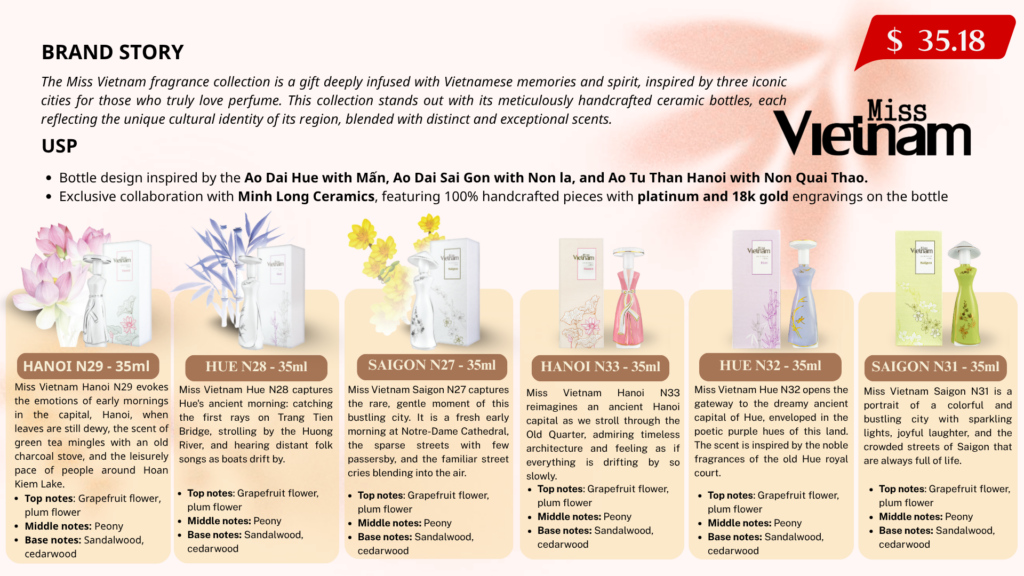
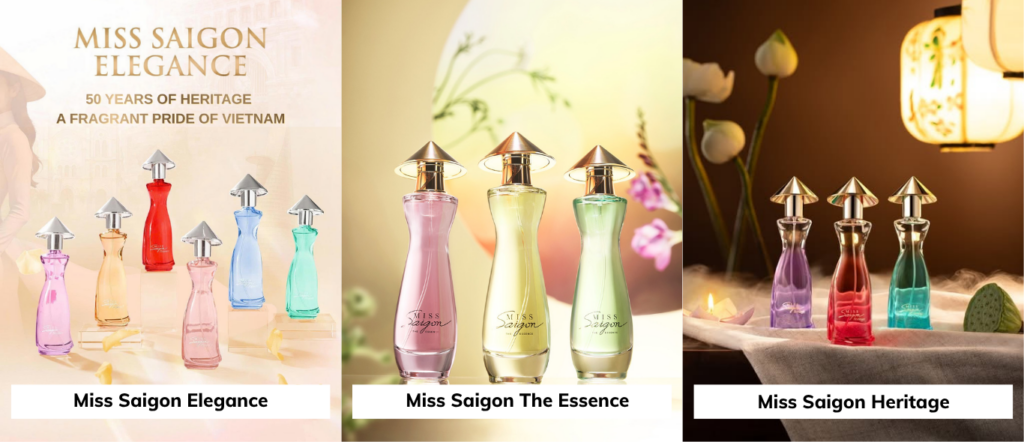
Miss Saigon is premium line, built around three collections — Elegance, Heritage, and The Essence — each with its own scent character, giving distributors some room to pick which collection fits their retail environment best.
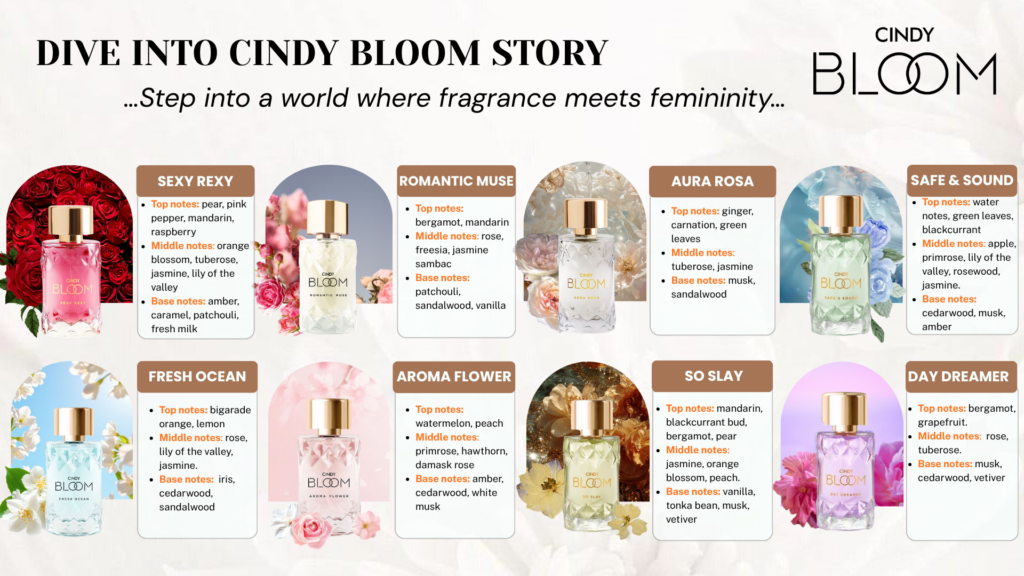
Cindy Bloom is squarely aimed at a younger, trend-driven buyer. It’s the line that moves fastest in mass retail and modern trade, and it’s also the one SCC positions closest to current fragrance trends rather than a fixed classic scent.
Cindy is the legacy mass-market line — an older, more established brand with a loyal older demographic, priced for high-volume retail rather than premium positioning.
Notes of Mekong is SCC’s built for buyers looking for something with a distinct regional identity rather than a mass-market scent profile. It’s also the line SCC has been developing most deliberately for international niche fragrance positioning.
Dynik covers men’s fragrance specifically, for distributors who want a dedicated line rather than a unisex or women’s-first catalog stretched to cover male buyers.
Knowing which of these lines fits your retail channel — duty-free, modern trade, mass retail, or a niche boutique concept — is a more useful starting point than asking a supplier for “your perfume catalog” broadly.
For Philippine distributors evaluating SCC against other options, the relevant facts are:
- Certifications: ISO 9001:2015 (Bureau Veritas-certified), CGMP-ASEAN compliant, and registered with the US FDA
- Existing export footprint: SCC currently exports to multiple markets including the Philippines, Cambodia, Malaysia, Indonesia, Singapore, and the United States
- OEM Solutions: SCC has produced for confirmed OEM partners including regional retail and healthcare chains, alongside its own portfolio of established fragrance brands
- Order flexibility: SCC supports lower MOQ arrangements for new distributor partnerships, allowing Philippine buyers to test a product line before scaling order volume
- Tariff position: As a Vietnam-based manufacturer, SCC products qualify for the ATIGA 0% preferential tariff when imported into the Philippines — a structural cost advantage over Chinese or Korean suppliers subject to standard tariff rates
These are the kinds of criteria distributors should be checking with any prospective supplier — not just claims on a homepage, but certifications, existing trade relationships, and cost structure that can be independently verified.
Questions to Ask Before Placing a First Order
Philippine importers evaluating any wholesale perfume supplier — including SCC — should ask directly:
- Can you provide certification documents (CGMP-ASEAN, ISO, FDA) for verification?
- What is your minimum order quantity for a first-time distributor partnership?
- Can you support private label development, or only white-label supply?
- What is the typical lead time from order confirmation to shipment?
Wholesale Perfume Suppliers Philippines willing to answer these clearly and provide documentation is a stronger signal of reliability than any marketing claim.
Contact SCC Export Team
Email: export@saigoncosmetics.com
Phone: +84 97 880 90 40
Website: www.scc-export.com
Location: Cat Lai Industrial Park, Ho Chi Minh City, Vietnam